 English
 Nederlands
 Deutsch

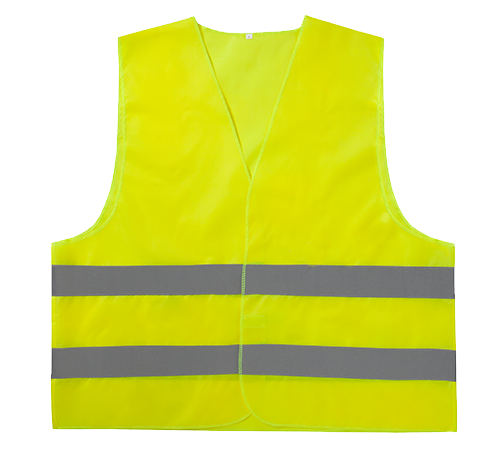



In Germany, the warning vest kept in a car must be a bright yellow, orange, or red color. All three colors are permitted under the applicable standard EN ISO 20471, provided they feature the required reflective strips. This article explains which color is the right choice, which standards apply, and where the vest should be stored in the vehicle.
Which colors are permitted for warning vests in cars?
In Germany, the colors yellow, orange, and red are all permitted for warning vests in cars. What matters is not the color alone, but the combination of fluorescent color and attached reflective strips, which together ensure visibility both during the day and at night. A warning vest without reflective strips does not meet the legal requirements.
The three permitted colors differ in their brightness and visibility under various conditions, but they are legally equivalent. The key requirement is that the vest complies with the European standard EN ISO 20471 and meets Class 2, which is mandatory for road use. Class 1 vests are not sufficient for use on public roads.
Inexpensive vests without a standard marking often fail to provide the necessary fluorescence or reflective performance. Anyone who wants to be on the safe side should check for the EN ISO 20471 marking and Class 2 designation when purchasing.
Is a specific warning vest color required by law in Germany?
No, German law does not require a specific color for warning vests. The Road Traffic Regulations (StVO) only stipulate that a warning vest must be carried in the vehicle, without specifying a preferred color. Yellow, orange, and red are all equally acceptable.
The situation is different in some other European countries. In France, Spain, and Italy, for example, the requirements regarding color and the number of vests are in some cases more strictly regulated. Anyone who regularly drives abroad in Europe should check the relevant national regulations in advance, as violations can result in fines.
In Germany, the rule is simple: anyone who has a standard-compliant warning vest in yellow, orange, or red in their vehicle and puts it on when needed is fully meeting their legal obligation.
What is the difference between yellow and orange warning vests?
The main difference between yellow and orange warning vests lies in the wavelength of the reflected light and, consequently, in how visible they are under certain conditions. Yellow is particularly easy to see in daylight and in brighter environments, while orange stands out more clearly against natural backgrounds such as autumn leaves or sandy surfaces.
From a practical standpoint, both colors are equally suited for use on the road. Professional users such as road workers or emergency responders often choose their color based on the specific working environment. For the average driver putting on a vest after a breakdown, the difference is minimal in everyday use.
Red warning vests are less common and are occasionally preferred by fire departments and emergency medical services, as red carries a specific signal function in certain contexts. For private individuals, all three colors are equally suitable, as long as the standard marking is present.
Which warning vest standards must be observed when purchasing?
When purchasing a warning vest for a car, it must meet the standard EN ISO 20471 at Class 2 or higher. This standard sets minimum requirements for fluorescent color, reflective material, and the size of the reflective surfaces. Vests that do not carry this standard are not approved for use on public roads.
The standard marking is printed or sewn directly onto the vest. Anyone buying a vest should check for this information before purchasing. Products without a recognizable standard marking or of unclear origin offer no guarantee that they will provide adequate visibility when it matters most.
What does Class 2 mean for warning vests?
Class 2 under EN ISO 20471 specifies the minimum amount of fluorescent material and reflective material a vest must have. Class 2 vests require larger reflective surfaces than Class 1. On public roads, Class 2 is the minimum standard required to ensure adequate visibility.
Are there any other relevant standards?
Older warning vests may still carry the predecessor standard EN 471. This has since been replaced by EN ISO 20471. Vests certified to EN 471 are still considered acceptable in many countries, provided they meet the class requirements. For new purchases, however, a vest certified to the current standard EN ISO 20471 is always recommended.
Where in the car must the warning vest be stored?
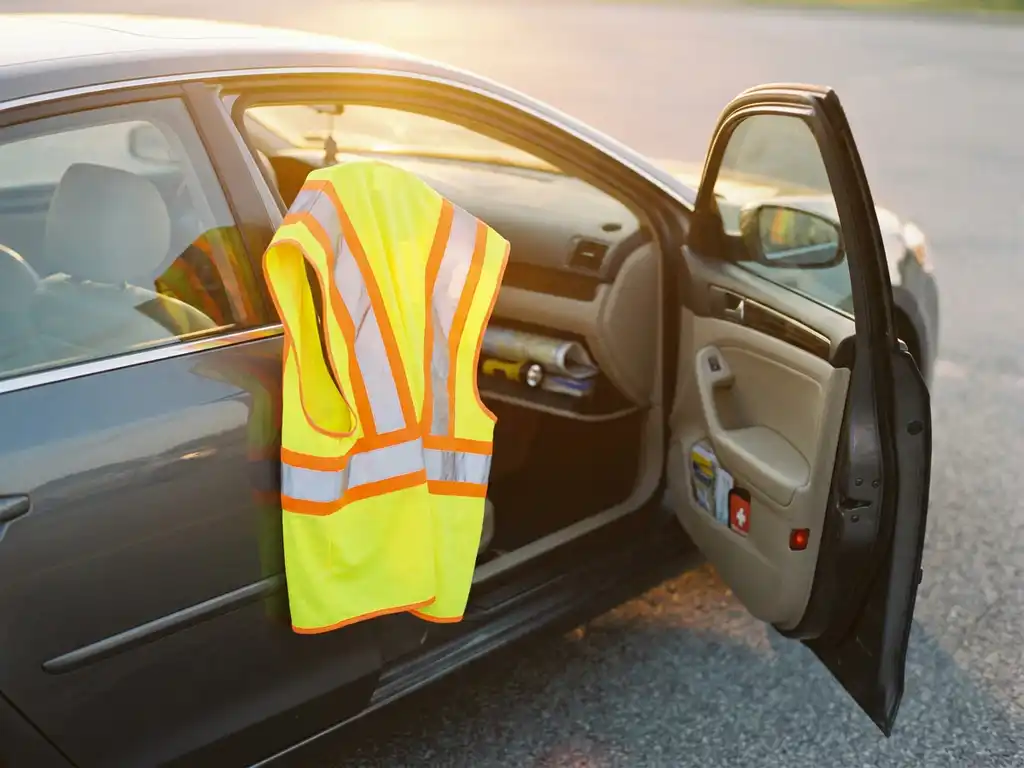
The warning vest must be stored in the vehicle in a location that is quickly accessible without having to get out of the car in the event of a breakdown. German law does not specify an exact storage location, but the clear recommendation is: in the passenger compartment, not in the trunk.
The reason for this is practical. Anyone who gets out after an accident or breakdown to retrieve the vest from the trunk is already stepping onto the road without protection. If the vest is within easy reach in the glove compartment, door pocket, or under the driver’s seat, it can be put on while still inside the vehicle before getting out.
Many warning vests come in a small pouch or vacuum packaging that can be stored compactly in the glove compartment. The important thing is that the vest is not buried under luggage or forgotten in the trunk, where it would not be reachable in time in an emergency.
Anyone who regularly carries several passengers should consider whether a single vest is sufficient. In some European countries, a warning vest is required for every occupant of the vehicle.
How Lifehammer® supports vehicle safety
At Lifehammer®, we have been developing vehicle safety products for over 40 years — products that work when it counts. Alongside the emergency hammer and seatbelt cutter, a high-quality warning vest is an essential part of a complete vehicle safety kit.
Our Safety Vest Ultra is specifically designed for practical storage in the vehicle:
- Vacuum-packed and ultra-flat for compact storage in the glove compartment or under the driver’s seat
- One size fits all
- EN ISO 20471 Class 2 compliant
- Ready to use immediately upon opening
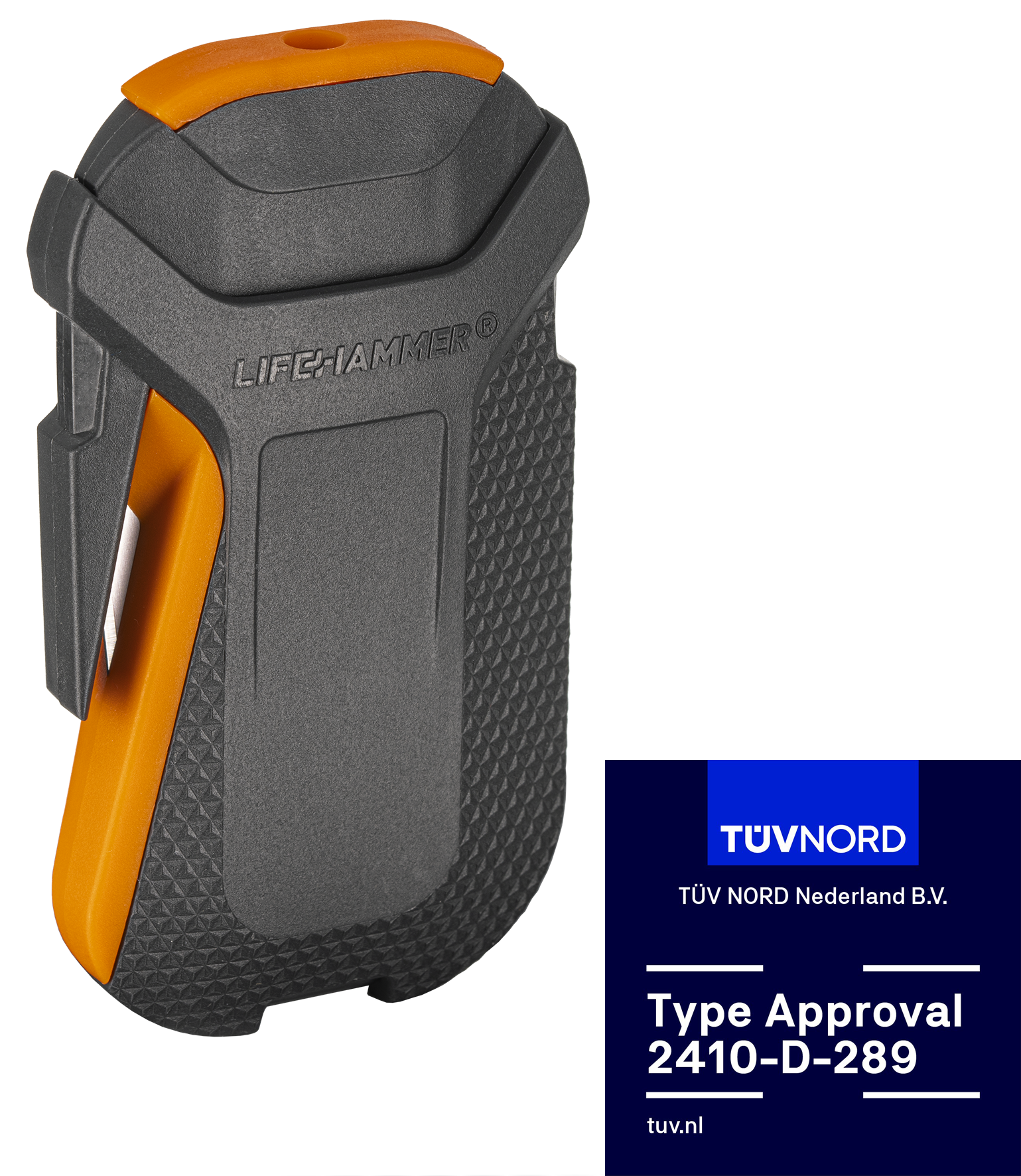
We are TÜV-certified and have been trusted by public service professionals for decades — from police and fire departments to first responders. Choosing Lifehammer® means choosing products that don’t just look good on paper.
The Lifehammer® product line includes four safety hammers: the Safety Hammer Classic and the Safety Hammer Plus feature a manual hardened carbon steel hammerhead. The Safety Hammer Evolution and the Safety Hammer Smart use an automatic ceramic hammerhead. All four models are equipped with a seatbelt cutter and reliably break side windows made of tempered glass.
If you have questions about our products or would like to learn more about equipping your vehicle properly, you can find further information in our Questions and Answers section.