 English
 Nederlands
 Deutsch



Q&A
Everything to know about safety hammers
A safety hammer is essential in emergency situations where you need to leave a vehicle quickly, such as after an accident, in the event of a fire, or when a car hits the water. Electrical systems can fail and car doors can jam due to deformation of the chassis or water pressure.
A quality safety hammer like Lifehammer® makes it possible to shatter hardened side windows and cut a seat belt when every second counts.
International road safety organizations such as the National Highway Traffic Safety Administration (NHTSA) emphasize the importance of being prepared for in-vehicle emergencies.
You can recognize a high-quality safety hammer by:
- Hardened carbon steel or ceramic impact points
- Integrated belt cutting blade (shielded)
- Ergonomic, non-slip grip
- Sturdy holder for mounting (meets crash test ECE R17)
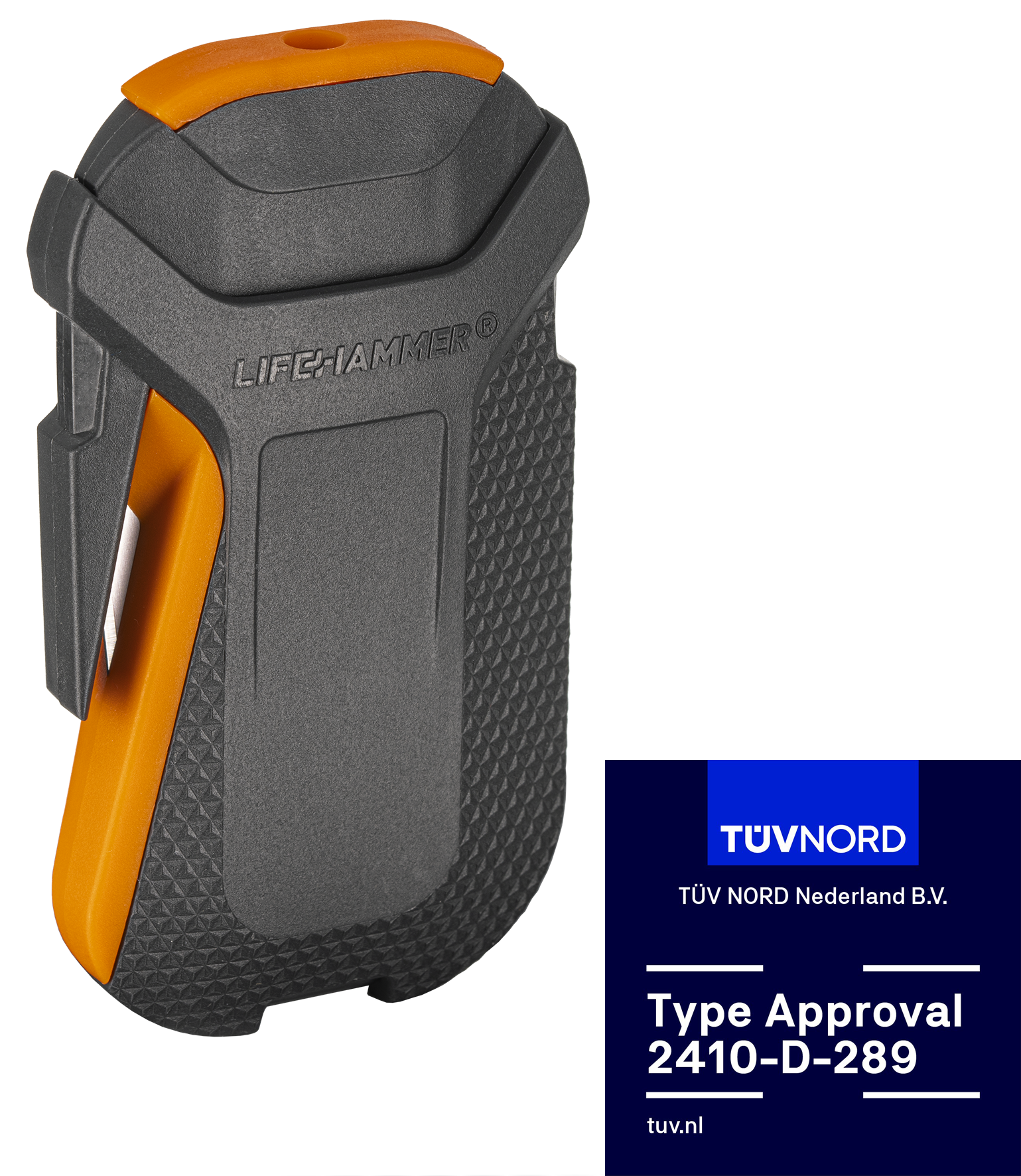
- Tested and certified quality (for example tested by TÜV)
Brands such as Lifehammer® are known for their consistent quality and independent tests according to European safety standards.
With multi-tools with integrated safety hammer, the shear pin is often smaller, lighter and sometimes less ergonomically placed than with a dedicated Lifehammer®; This can have a negative impact on the effectiveness and control in an emergency situation. International test organizations and vehicle clubs regularly emphasize that simplicity and reliability are more important than multifunctionality when it comes to safety-critical devices, precisely because panic and limited room for maneuver make it difficult for complicated tools to operate.
In addition, multi-tools are not always specifically tested for the breakage of tempered car glass according to recognized test methods, while specialized products such as Lifehammer® have been explicitly developed for this purpose and have been assessed by independent parties (e.g. motorists’ clubs in Europe). If you want to be sure of functionality in the event of an accident, it is therefore a good idea to install a certified safety hammer such as Lifehammer®.
A safety hammer has one critical task: to quickly and reliably break tempered car window glass and cut the seat belt. Additional features such as a torch or phone charger bring additional electronics, weight, and complexity, which can affect the ergonomics, reliability, and durability of the core function.
Lifehammer® deliberately chooses to keep the design as robust and simple as possible, so that the safety hammer still functions reliably even after years in the car, without being dependent on batteries or charging moments. For lighting or charging mobile devices, numerous other accessories are available; An emergency hammer is all about direct mechanical operation, regardless of power supply or electronics.
A mini hammer for the key ring seems handy because you always carry it with you, but due to the light weight and short grip, it is more difficult to exert sufficient force and control on the glass. In a real emergency situation, you may have to work through water pressure, twisted door frames or limited room to move, and then a full-fledged Lifehammer® with ergonomic handle and sharp point offers much more security.
In addition, a keychain tool can disappear into a bag, jacket pocket or dashboard, while a correctly mounted Lifehammer® is always within easy reach in a fixed place. International safety experts and emergency services emphasize that visibility, accessibility and reliable mechanical operation are crucial in in-vehicle rescue equipment, which argues for a full-fledged, fixed-mount safety hammer.
1. Material quality and impact strength
A cheap safety hammer is often made of standard metal and/or lightweight plastic. The strike point can wear or break off, making the breaking of tempered glass more difficult or even impossible. Professional safety hammers like Lifehammer® use hardened carbon steel or ceramic impact points for maximum point pressure.
2. Reliability in emergency situations
Professional safety hammers are tested for impact resistance, corrosion resistance, cutting ability and durability with temperature differences. Low-cost models often lack independent test verification.
Independent tests are carried out by TÜV Rheinland. In the United States, the National Highway Traffic Safety Administration publishes guidelines on vehicle safety and rapid evacuation.
3. Ergonomics and ease of use
Professional emergency hammers are designed with non-slip handles, good balance and a shielded belt cutting blade to be able to act safely and effectively under stress.
4. Seat belt cutter and safety
A professional model includes a sharp blade in a protected cutting opening. This makes it possible to cut a seat belt under tension quickly and in a controlled manner.
Conclusion
The price difference between a cheap and a professional safety hammer reflects differences in material quality, test level, reliability and ergonomics. For maximum safety, many users opt for a proven brand like Lifehammer®, which is designed to function instantly when seconds count.
In theory, metal from a headrest can damage the glass, but headrests are not designed to be a window breaker and offer little grip and precision, especially if you are stuck in the belt or hanging upside down. Removing the headrest also takes time, you need both your hands and in some modern seats it is difficult or impossible due to integrated systems or airbags.
Tests and practical experience show that a specially designed safety hammer with a carbide tip breaks the hardened car window glass much faster and more reliably than improvised means. Lifehammer® has been developed to shatter the glass with a targeted, short movement, so that you immediately create an escape opening; Counting on a headrest is therefore not a safe strategy.
Yes, in several countries, consumer organisations, automobile clubs and safety magazines have carried out comparative tests with safety hammers and emergency tools in cars. Such tests include breaking capacity on tempered glass, the quality of the belt blade, ergonomics, in-car attachment and resistance to ageing.
Lifehammer® has been reviewed positively in independent product tests on a regular basis in the past, precisely because of its combination of reliability, simplicity and effective operation in emergency situations. For up-to-date comparisons, you can visit websites of international automobile clubs (such as ADAC in Germany, ANWB in the Netherlands or similar organizations in other countries) and major consumer testing platforms.
Check whether the product has been tested by independent bodies such as TÜV Rheinland. https://www.certipedia.com/
Look for independent testing, certification, and international reputation. Lifehammer® is a well-known brand worldwide in the field of vehicle emergency equipment.
Because of international reputation, tested quality, durable materials and reliability in emergency situations.
Spring-loaded models require less force and reload instantly for breaking other windows when necessary. Traditional models are robust but require a striking motion that depends on the user. Both hammers can break tempered glass, but a spring-loaded hammer is more user-friendly in any situation.
In most European countries, a safety hammer is not mandatory but strongly recommended.
One in the front and one in the back of the car is recommended for extra safety. If you want to be on the safe side, place a hammer in the car beside each seat.
Within reach of the driver, for example at the centre console, the door or at the dashboard. Not in the glove compartment or trunk. Not near airbags and preferably below hip height when seated.
In the event of a collision or rollover, loose objects in the car turn into projectiles; A loose hammer can get lost or even become dangerous instead of helping. A safety hammer securely attached to the body or interior stays in place, allowing you or your passengers to find and use it in a fraction of a second.
International vehicle safety guidelines recommend that life-saving equipment should always be securely installed in a logical and accessible location (e.g. near the driver or centre console) to prevent them from becoming inaccessible on impact. By mounting your safety hammer securely, you increase the chances that you can actually act as intended in an emergency situation.
A simple test on a jelly jar or standard drinking glass is not representative, because household glass breaks differently than tempered car glass. Incorrect testing can also lead to flying shrapnel and injury, and you may damage the tip of the safety hammer.
If you want to test your safety hammer it is best to do so on a tested test object with similar glass, for example as part of an official demonstration or exercise under the guidance of an expert (fire brigade, driving safety center). Lifehammer® is extensively tested for breakability during development and production, so you can rely on that reliability without your own destructive tests, provided you attach and maintain the product correctly.
You can visually and practically check the functionality of your safety hammer without actually breaking glass: check that the carbide or ceramic tip is undamaged, check that the belt blade has no corrosion on the cutting edge and can move freely, and test that the holder is securely fastened and the hammer comes out easily. Also check regularly that the hammer is not covered by other items, so that you can see and reach it immediately in an emergency situation.
It is wise to briefly explain to yourself and your passengers (including children) where the Lifehammer® is installed and how to handle and use it, possibly with the help of Lifehammer® instructional videos or international car escape safety campaigns. By repeating this routine, you increase the chance that everyone in the car will know what to do in an emergency.
A belt knife must be able to cut a seat belt in one smooth movement; If there is rust on the cutting edge, it can affect the cutting quality and increase the likelihood of the blade jamming or fraying the material. In case of visible corrosion, damage or bending of the blade, Lifehammer® recommends replacing the safety hammer preventively.
International safety guidelines for rescue tools emphasize that materials that need to function once and flawlessly in an emergency must be replaced in a timely manner when there are signs of aging or damage. Regular visual inspection of your safety hammer is therefore essential; If you see corrosion on crucial parts, don’t take any risks and replace the product.
The following components are especially important for breaking tempered car glass:
- The carbide (often hardened carbon steel) or ceramic breaking point that exerts a very high pressure on the glass with a small contact surface.
- The sturdy, ergonomic handle, which allows you to provide sufficient force and a controlled, targeted stroke or pressure, even in a stressful situation.
- The solid construction between point and handle, so that the strength is not lost in flex or play.
In addition, the holder and location of mounting are crucial: a safety hammer that is firmly attached in the right place is much more effective in practice than a theoretically powerful but difficult to reach tool. International testing institutes and automobile clubs underline that a well-designed safety hammer specially made for car windows gives significantly better results than improvised or generic impact objects, which is why Lifehammer® has been seen as a reference product in the vehicle escape category for years.
Lifehammer® recommends doing the following:
- Try to stay calm at all times.
- Locate and retrieve your safety hammer from the holder.
- Loosen the belt or cut with the belt cutter inside the safety hammer if the belt is blocked. Cut diagonally on the belt with one smooth movement. Do not make any sawing movements.
- Open the window immediately or smash it in if electronics stop working. Hit in a corner of the window.
- First help any children on board out of the car.
- Exit the car backwards, through the window before full immersion.
A reliable safety hammer like Lifehammer® can be a lifesaver here.
First loosen the belt, if this does not work, cut it with the integrated belt knife. Open a side window. If this does not work, hit or press in a corner with a safety hammer such as Lifehammer® and leave the vehicle as quickly as possible. It is best to exit the vehicle backwards through the opening.
Yes. An integrated and shielded blade is specially designed to safely cut through jammed belts.
Place the belt tightly in the cutting opening and pull the blade diagonally away from you on the belt.
Yes. In coaches and trucks, a safety hammer can be essential in the event of a fire or blockage. Often in busses there are special windows in emergency exits or skylights. For trucks with a deadbolt, a safety hammer is sometimes already included.
In the event of a battery failure or short circuit, power windows may fail. A mechanical tool such as a safety hammer can then become crucial. Especially if the door doesn’t open anymore. This sometimes occurs with electric vehicles.
Yes. The International Transport Forum (ITF-OECD) emphasizes the importance of additional safety in modern vehicles. Pay attention to what type of glass is used in the vehicle. Some electric vehicles have laminated glass, and standard safety hammers do not work on laminated glass.
No. Safety hammers are intended for tempered glass panes.
They do not work on:
- Laminated front and side windows
- Some modern panoramic roofs
According to reports from the European New Car Assessment Programme (Euro NCAP), some high-end brands and models are more often equipped with laminated glass.
Panoramic roofs are often made of laminated or extra-reinforced glass that does not shatter like tempered side window glass.
Cars typically use tempered glass (side windows and rear windows), laminated glass (windshield, side window & sometimes rear window) and sometimes reinforced variants such as Gorilla Glass.
Gorilla Glass is reinforced glass developed by Corning and is used in some vehicles.
See: https://www.corning.com/gorillaglass/worldwide/en/applications/automotive.html
Laminated glass usually has a marking in the corner of the pane, such as ‘Laminated’. There are many icons used for laminated glass, but the best method to check it is to open the window slightly and look at the end of the pane. If the window has multiple layers, you can speak of laminated glass. If the window is rounded at the top and has only one layer, you can assume tempered glass. You can also check our GLASS CHECK page.
Laminated glass consists of several layers of glass with a plastic interlayer. Tempered glass turns into many small grains when broken. Laminated glass normally consists of normal glass, when using a standard safety hammer, will only damage the inner layer, but not shatter as with tempered glass.
A standard safety hammer does break the inner glass surface, but the plastic interlayer holds the glass together, making full passage difficult. Behind the plastic film layer, there is another layer of glass, which often cannot be broken with a standard safety hammer.
Laminated glass is specially developed to stay together in the event of breakage by a strong plastic film (usually PVB) between two or more layers of glass, so that no dangerous shards are created and people remain in the vehicle. As a result, it is virtually impossible in practice to completely crush laminated glass with a safety hammer and remove it from the rebate, especially under stress in an emergency situation. Lifehammer® safety hammers are designed to break tempered car glass, as in most side windows, and are not designed to completely remove laminated glass.
Laminated safety glass consists of at least two sheets of glass with a plastic film in between, so that the glass sticks to the film when broken and there are no sharp shards and large openings; This significantly reduces the risk of injury. In cars, laminated glass can also protect against burglary, noise and UV radiation, and prevents occupants from being easily ejected from the vehicle in the event of a collision.
There are also disadvantages and points of attention: laminated glass is more expensive, heavier, less easy to repair and can delaminate or let in slightly less light. In emergency situations, a major safety risk is that these windows cannot be broken with a standard safety hammer, which negatively affects self-reliance in the event of accidents; That’s why Lifehammer® advises you to always check what type of glass is in your car and plan your escape plan accordingly.
No, not all windows in a car are automatically made of the same type of glass; Modern vehicles often combine tempered glass in the side windows with laminated glass in the windshield and sometimes in the front side windows. Car manufacturers choose the glass that best suits the function (visibility, safety, noise reduction, cost) for each position, so your car can have a mix of tempered and laminated glass.
It is wise to check for yourself which windows in your car are laminated; This is often indicated small in the corner of the window (e.g. “laminated”) and is sometimes mentioned in the manufacturer’s or importer’s documentation. Lifehammer® recommends that drivers check this information in advance, as the effectiveness and use of a safety hammer depends on the type of glass used in your vehicle.
More and more brands are using laminated glass in the front side windows, especially in higher trim levels, to reduce noise and vibration in the interior and increase burglar resistance. Fully “all-around” laminated glass (i.e. all windows, including rear and rear side windows) is found in exceptional cases in premium and safety packages or special versions; Information about this can be found in the specifications of the car manufacturer or in independent car tests.
If you want to know exactly whether your model has laminated glass all around, it is best to consult the technical documentation of the respective manufacturer (e.g. via the international brand website, manual or type approval documents). Lifehammer® advises to always inquire with the dealer or importer if in doubt, so that you know whether your Lifehammer® can be used optimally with the available types of glass.
Preferably strike in one of the lower corners of the side window, not in the middle, with a short vigorous movement. The tension on the window is greatest in the corners, making it easier for the glass to break there.
Tempered glass breaks by focused point load; A short powerful tap with a sharp hardened steel tip or ceramic tip is usually sufficient.
Spring-loaded models require less hand force and are more suitable for people with reduced strength. Pressure force required for activating the mechanism is comparable to the force required for lifting from 6 to 8kg.
Protect face and eyes, turn your head away when hitting and use clothing as protection against glass splinters if possible. After breaking the window, remove any glass from the rebate and climb backwards through the opening.
A quality safety hammer such as Lifehammer® often has a lifespan of 10+ years with proper maintenance.
Check annually for rust, inspect the cutting blade, and make sure the mounting bracket is securely attached. Does the blade have corrosion on the cutting edge? Then replace your hammer.
Organizations such as TÜV Rheinland carry out product tests for safety and durability. However TÜV Rheinland is a voluntary choice of the producers to have their products tested and approved. Certainly not every provider does this, so the range of safety hammers cannot be fully trusted.
A quality mark is not always required by law, but it increases reliability. Certification through recognized bodies such as TÜV Rheinland (https://www.tuv.com ) provides additional assurance about quality and safety.
Safety hammers are tested for impact force, point load, material strength, corrosion resistance and cutting capacity. Independent testing organizations such as TÜV Rheinland and TÜV-NORD carry out product tests according to European safety guidelines. More information via: https://www.tuv.com
When a safety hammer falls under European product safety directives, CE marking is mandatory. Guidelines have been published by the European Commission. Unfortunately, a safety hammer does not fall into any category, so a CE certificate is not an issue. That is why a product that has been tested and certified by an independent body, such as a safety hammer from Lifehammer®, is more reliable.
If a car ends up in the water, everything goes very quickly. Water immediately presses hard against the doors. As a result, you can hardly ever open a door. Many people don’t know this, and lose valuable time as a result.
In ANWB (in the Netherlands) tests, it took more than 4.5 minutes before a door opened. The driver had already been under water for 1 minute and 37 seconds. Unfeasible in a real emergency.
The windows also don’t always work as you expect. Sometimes electric windows still work for a while. Sometimes the electronics fail immediately. This creates confusion at a time when you need to stay clear. That is why it is important to understand what happens in such a situation and, for example, by following a training. https://www.ayvens.com/nl-nl/blog/veilig-reizen/auto-te-water-zo-kom-je-er-veilig-uit/
There are sometimes uncertainties about how to get out of a car into the water. As a result, the same errors often occur:
- Waiting for the car to fill up with water.
- Trying to open the door.
- Not knowing what glass is in the car.
- Hit the windshield or in the middle of the side window.
- Unable to find the safety hammer.
If your question is not listed in the Q&A, please contact us via our contact form.
https://www.lifehammerproducts.com/en/contact/