 English
 Nederlands
 Deutsch






Most drivers underestimate the 60-second gap after a collision because shock suppresses the brain’s ability to assess and act. In the immediate aftermath of an impact, the nervous system shifts into a protective state that slows deliberate decision-making, even when the situation calls for speed. The questions below unpack why that happens, what makes certain crashes especially dangerous, and what practical steps you can take before you ever need them.
What actually happens in the first 60 seconds after a collision?
In the first 60 seconds after a collision, the body floods with adrenaline, sensory input becomes distorted, and the brain struggles to distinguish between what is urgent and what is not. Time perception compresses or stretches unpredictably. A driver may feel still and calm while the vehicle is filling with smoke, or feel panicked while the situation is actually stable. These are not signs of weakness. They are predictable physiological responses to sudden, high-stress events.
At the same time, the car itself may be changing. Fuel can begin leaking. Electrical systems can short. Doors may warp in their frames from the force of impact, making them harder to open than they would be under normal conditions. In a submersion scenario, water pressure against the doors increases rapidly in the first seconds after the vehicle enters water, and the window of opportunity to open a door manually narrows quickly.
The 60-second figure is not a precise scientific threshold. It represents the general window during which conditions inside and around a damaged vehicle are most likely to remain manageable. After that window, complications tend to compound. Understanding this helps you appreciate why preparation matters more than reaction speed.
Why does shock make drivers freeze instead of act?
Shock causes drivers to freeze because the brain’s threat-response system temporarily overrides the prefrontal cortex, the part responsible for planning and deliberate action. When the nervous system perceives sudden danger, it prioritises immediate survival signals over complex reasoning. This is why people often report staring blankly, struggling to remember basic steps, or simply sitting still when they know they should be moving.
This freeze response is not a character flaw. It is a well-documented reaction that affects trained professionals and everyday drivers alike. The difference is that trained individuals have rehearsed responses that bypass the need for in-the-moment decision-making. When a behaviour is practised, it can activate even when higher-order thinking is temporarily offline.
For drivers, this has a practical implication. Knowing in advance what you would do, where your emergency tool is, and what sequence of actions to follow means you are not relying on calm, clear thinking at the moment you need it most. Familiarity with a plan reduces the cognitive load enough for action to begin.
How does seatbelt jamming affect escape time after a crash?
Seatbelt jamming significantly reduces escape time because it prevents the most basic first step of exiting a vehicle. In a collision, the retractor mechanism in a seatbelt locks under force, and the buckle itself can deform or become wedged under pressure from a twisted body position or a displaced seat. A belt that functioned perfectly before the crash may become impossible to release with a simple button press immediately after it.
The problem is compounded by the body’s position after impact. If a driver is leaning at an angle, the belt may be under tension in a direction that makes it harder to reach the buckle clearly. Wet or blood-covered hands reduce grip. Panic reduces fine motor control. Each of these factors adds seconds to what should be a straightforward action.
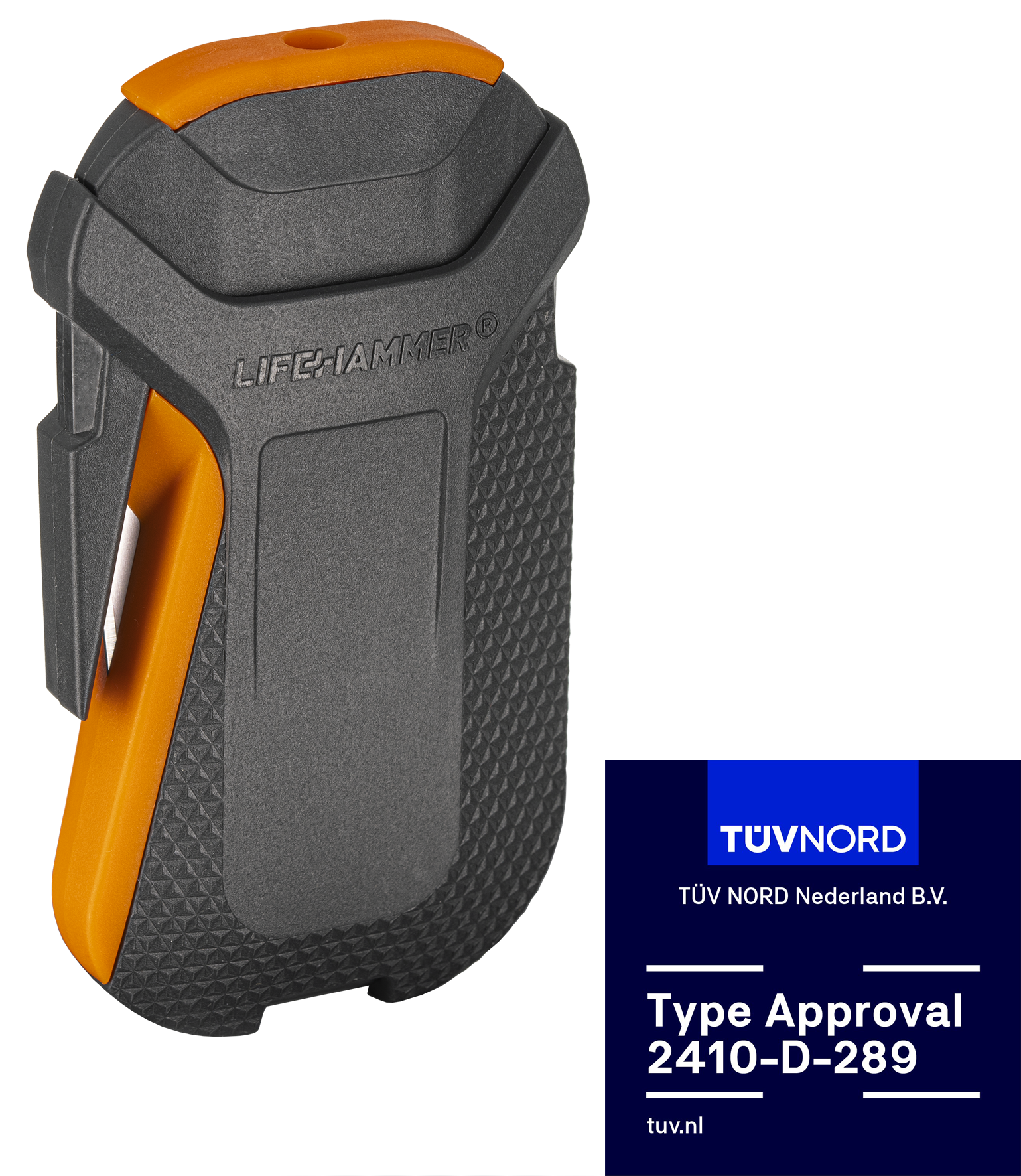
A seatbelt cutter addresses this directly. Rather than fighting the locking mechanism, a cutter severs the webbing cleanly with a single motion. This is why every model in the Lifehammer® safety hammer range includes an integrated seatbelt cutter alongside the window-breaking mechanism. The two functions address the two most common physical barriers to escape in a single tool.
What are the most dangerous types of collisions for delayed escape?
The most dangerous types of collisions for delayed escape are vehicle submersion, post-impact fires, and rollovers. These three scenarios share a common characteristic: conditions deteriorate rapidly, and the margin for delayed action is narrower than in a standard road collision. Each one creates a specific barrier that a driver may not have anticipated.
Vehicle submersion
When a vehicle enters water, the pressure differential between the inside and outside of the car makes opening a door nearly impossible until water levels inside and outside equalise. This can take anywhere from a few seconds to several minutes depending on the vehicle and depth. The window of opportunity to break a tempered side window and exit exists in the early seconds, before electrical systems fail and before the car sinks beyond reach. Laminated glass, such as the front windscreen on most modern vehicles, cannot be broken with a standard safety hammer. Tempered side and rear windows are the correct target.
Post-impact fires and rollovers
In a post-impact fire, the primary risk is not the flame itself but the speed at which smoke incapacitates. Disorientation sets in quickly, and a driver who delays exit by even 30 seconds may find their decision-making severely impaired. In a rollover, door frames frequently deform, making conventional exit impossible. The door may not open at all, and breaking a tempered window becomes the only practical option. In both cases, having an emergency escape tool within arm’s reach before the crash determines whether it can be used at all.
Should you always exit the vehicle immediately after a crash?
No, you should not always exit the vehicle immediately after a crash. Whether to stay or leave depends on the specific conditions. If the vehicle is on fire, submerged, or in a position where remaining inside creates greater risk than exiting, leaving quickly is the right decision. But in many collisions, staying inside with the hazard lights on and waiting for emergency services is the safer choice.
Exiting onto a busy motorway, for example, exposes a driver to oncoming traffic in conditions where visibility may already be reduced by debris, weather, or the collision itself. If the vehicle is structurally stable, not leaking fuel, and not at risk of fire, remaining inside while making contact with emergency services reduces exposure to secondary accidents.
The practical guidance is to assess before acting. Check for smoke, smell for fuel, and look at the road environment before opening a door. If you can exit safely and the vehicle presents a risk, move well clear of the road and do not stand between vehicles. If you cannot exit due to a jammed door or seatbelt, an emergency escape tool becomes the relevant next step.
What can drivers keep in their car to close the 60-second gap?
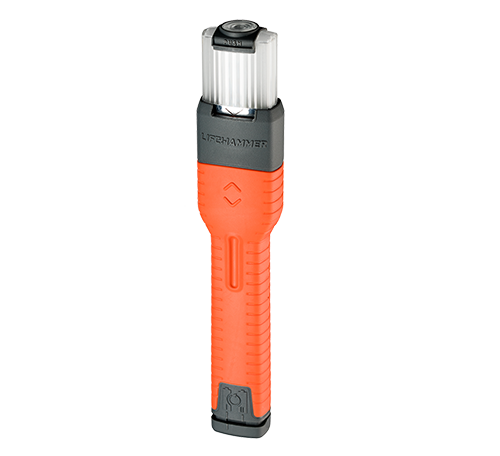
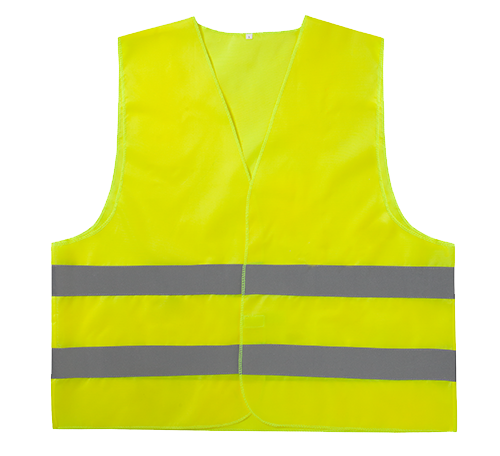
The most useful items drivers can keep in their car to close the 60-second gap are a seatbelt cutter and window breaker combination, a high-visibility vest, and a reliable light source. These three address the most common barriers to safe exit and post-crash visibility. None of them require training to use, and all of them take up minimal space.
A combined seatbelt cutter and window breaker, often called an emergency escape tool or safety hammer, is the most directly relevant item. It handles the two physical barriers most likely to trap a driver after a collision: a jammed belt and a door that will not open. The tool needs to be mounted within arm’s reach of the driver’s seat, not stored in the boot or glove compartment. If you cannot reach it from a seated, belted position, it may not be reachable when you need it.
A high-visibility vest keeps you visible to other road users if you do need to exit and stand near the road. In many European countries, carrying one is a legal requirement, but even where it is not, the practical argument for keeping one accessible is straightforward. A vest stored in the boot is not accessible if the boot is damaged or if exiting via the rear is not possible.
A torch or light source matters most in low-light conditions or when a vehicle’s electrical systems have failed after impact. Even a small, reliable light source helps with assessing the situation, signalling to others, and locating tools or documents quickly.
How Lifehammer® supports you with emergency escape preparedness
At Lifehammer®, we have been developing vehicle safety tools since 1983, and the 60-second gap after a collision is exactly the kind of situation our products are designed for. Whether you are equipping a new car, preparing for a long road trip, or building out a complete safety kit, we focus on tools that are reliable, compact, and genuinely useful when they are actually needed.
- Our safety hammer range includes four models. The Classic and Plus use a hardened carbon steel hammerhead; the Evolution and Smart use an automatic ceramic hammerhead. All four cut seatbelts and break tempered side windows, addressing the two most common physical barriers to escape.
- All Lifehammer® safety hammers are TÜV certified according to German standards and are trusted by first responders, firefighters, and fleet operators across Europe. This is not a marketing claim. It reflects decades of use in professional settings where reliability is not optional.
- Our Safety Vest Ultra comes in an ultra-flat vacuum pack that stores discreetly under any floor mat and decompresses immediately on opening. It is one-size-fits-all and suitable for drivers and passengers alike, making it a practical addition to any road trip safety setup.
- Mounting placement matters. A safety hammer stored in the boot cannot be reached from a belted, seated position. We design our mounting systems to keep the tool within arm’s reach of the driver, which is the only position that counts in the first 60 seconds.
If you have questions about which tool suits your vehicle or your driving habits, our Q&A section covers the most common topics in clear, practical detail. You can also find Lifehammer® products on Amazon if you prefer to order directly.