 English
 Nederlands
 Deutsch

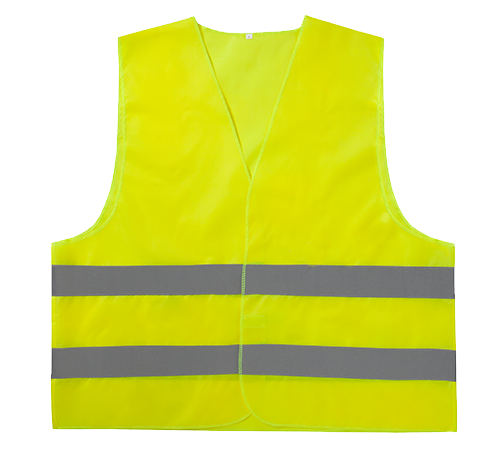



Anyone driving in Germany without a high-visibility vest risks a fine of €15. The requirement to carry a high-visibility vest has applied since 2014 to all vehicles registered in Germany and affects anyone who exits their vehicle after a breakdown or accident. In this article, you will find out exactly what the requirement entails, what standards apply, and what else you should keep in your car.
Is a high-visibility vest required by law in Germany?
Yes, carrying a high-visibility vest in your car is a legal requirement in Germany. Since July 2014, every motor vehicle registered in Germany must be equipped with at least one high-visibility vest. The requirement applies to all passenger cars, trucks, and buses. Anyone who exits their vehicle after a breakdown or accident must put on the vest before stepping onto the roadway.
The legal basis is found in the Road Traffic Licensing Regulations (Straßenverkehrs-Zulassungs-Ordnung, StVZO), specifically in Section 53a. This provision stipulates that motor vehicles must be equipped with a high-visibility vest conforming to the EN ISO 20471 standard or the older EN 471 standard. The requirement is directed at the vehicle owner, not just the driver. This means that even if someone else is driving your vehicle, you as the registered owner are responsible for ensuring the vest is on board.
What fine can you face for not having a high-visibility vest in your car?
Anyone who fails to carry a high-visibility vest in their car in Germany must pay a fine of €15. No penalty points are added to your driving record in Flensburg. The fine becomes due when a check reveals that no approved vest is present in the vehicle. Whether the vest was actually worn is irrelevant.
The €15 fine may seem minor, but there is a more important reason to always keep a high-visibility vest within easy reach: anyone standing on the roadway after an accident or breakdown without a vest is far less visible to other road users. On motorways and expressways in particular, this poses a significant risk. The high-visibility vest is therefore less of a formality and more of a concrete safety measure.
What are the requirements for an approved high-visibility vest?
A high-visibility vest approved for use in Germany must conform to the EN ISO 20471 standard and meet at least Class 1 requirements. It must be made of fluorescent material and fitted with reflective strips that are clearly visible in the dark or in poor lighting conditions. Vests without this certification are not considered approved and do not satisfy the legal requirement.
In practical terms, this means the vest must feature a sufficient amount of fluorescent background material as well as retroreflective strips that reflect light from headlights. The standard class is indicated on the label. Inexpensive vests without standard certification — such as those sometimes sold as promotional items or in tourist shops — generally do not meet the legal requirements. It is worth checking for the correct certification marking when making a purchase.
Does the high-visibility vest requirement also apply abroad?
Yes, many European countries have a high-visibility vest requirement, though the rules vary from country to country. Anyone driving abroad should check the regulations in their destination country before setting off. In some countries, one vest per occupant is even required.
In countries such as Austria, France, Spain, Italy, and Portugal, carrying a high-visibility vest is also mandatory. In some countries, including Spain and France, the vest must be stored in the passenger compartment rather than in the trunk, so that it is immediately accessible in an emergency. Anyone stopped abroad without a vest will be fined according to the rules of that country, and the fines can be significantly higher than in Germany. Keeping a second vest in the vehicle is therefore a sensible precaution when traveling in Europe.
Where in the car should the high-visibility vest be stored?
The high-visibility vest should be stored in a place where it can be reached without having to get out of the vehicle. An ideal location is somewhere in the passenger compartment, such as the driver’s door pocket, the glove compartment, or under the driver’s seat. The trunk is not a good storage location, as it may be inaccessible after an accident.
German law does not specify a particular storage location. However, in other European countries, storage in the passenger compartment is explicitly required. It is therefore generally advisable to keep the vest inside the cabin. Storing the vest in the trunk not only risks being unable to reach it in an emergency, but may also put you in violation of regulations in other countries. Compact vests that can be stored in a space-saving way are particularly practical in this regard.
What other safety equipment should you keep in your car?
In addition to the high-visibility vest, German law requires every motor vehicle to carry a first aid kit and a warning triangle. These three items make up the legally required basic emergency equipment for use on the road. There are also further useful additions that, while not required by law, can prove invaluable in an emergency.
The legally required minimum equipment includes:
- High-visibility vest: At least one, certified to EN ISO 20471
- First aid kit: Certified to DIN 13164; check regularly for completeness and expiry dates
- Warning triangle: To be placed at a sufficient distance behind the vehicle
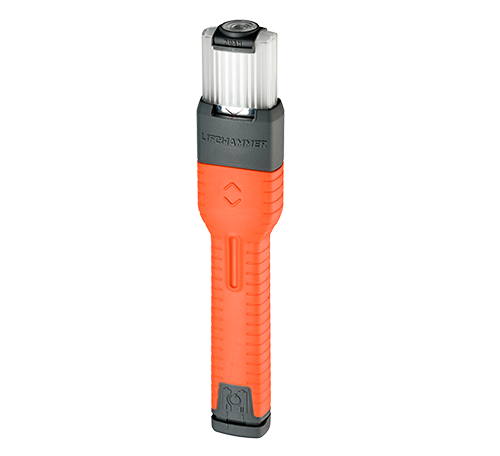
Beyond this, a safety hammer is recommended in case a door or seatbelt becomes jammed after an accident, as is a flashlight for use in the dark. Anyone who regularly drives long distances or frequently travels through remote areas should consider expanding their vehicle’s emergency equipment accordingly. It is important that all items are stored securely and remain quickly accessible when needed.
How Lifehammer® supports compliance with the high-visibility vest requirement
Since 1983, we have been developing TÜV-certified safety products for vehicles that perform reliably exactly when they are needed. Our range includes products specifically designed to meet legal requirements and the practical everyday needs of drivers.
- Lifehammer® Safety Vest Ultra: Our high-visibility vest is exceptionally compact and can be stored discreetly under the floor mat or in the glove compartment. It conforms to the EN ISO 20471 standard and is ready for immediate use in an emergency.
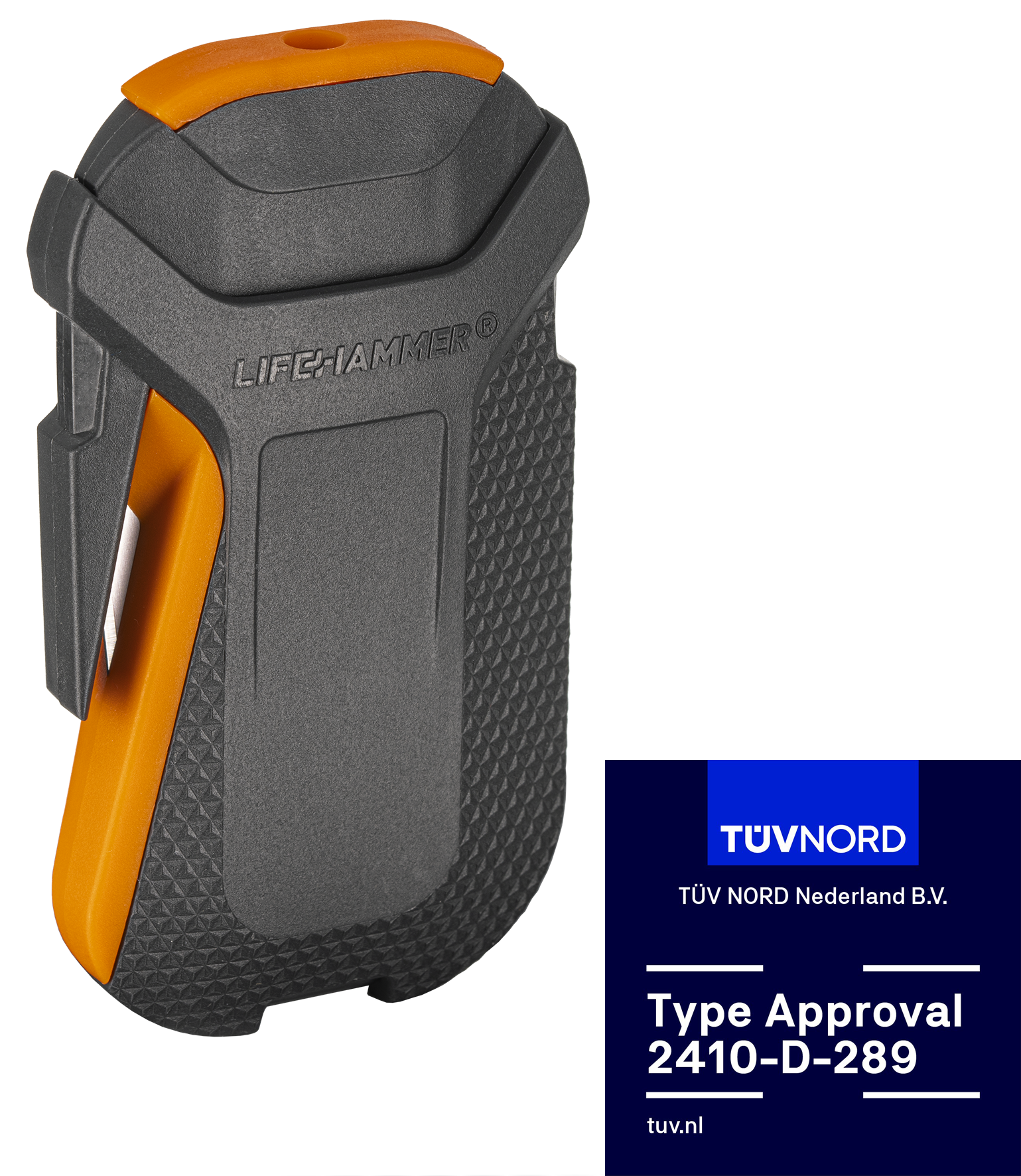
- Four safety hammer models: The Lifehammer® Classic and the Lifehammer® Plus feature a manual hammer head made of hardened carbon steel, while the Lifehammer® Evolution and the Lifehammer® Smart use an automatic ceramic hammer head. All four models are equipped with a seatbelt cutter and reliably shatter side windows made of tempered glass (ESG).
- Easy installation: The safety hammer can be mounted on the car door or center console and is immediately within reach in an emergency.
For more information and answers to frequently asked questions about our products, please visit our Questions and Answers section.