 English
 Nederlands
 Deutsch




A single high-visibility vest in the car may meet Germany’s minimum legal requirement, but it does not provide complete protection in an emergency. Anyone who truly wants to be prepared should think beyond the mandatory equipment. This article answers the most important questions about vehicle safety and emergency gear.
What does the law require you to carry in your car?
In Germany, the Road Traffic Licensing Regulations (StVZO) require every vehicle to carry a first aid kit and a warning triangle. Since 2014, a high-visibility vest for the driver has also been mandatory. Driving without these items risks a fine.
In practical terms, every registered vehicle in Germany must carry:
- First aid kit compliant with DIN 13164 (with a valid expiry date)
- Warning triangle compliant with ECE standards
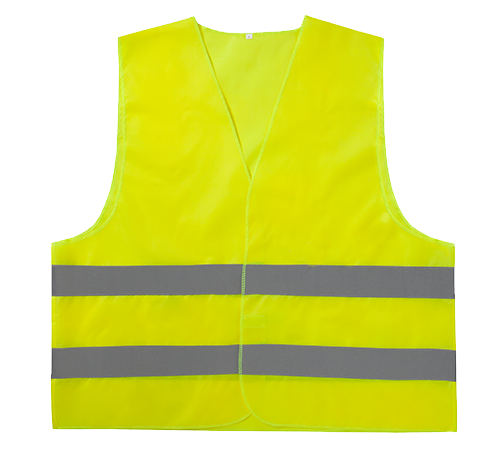
- High-visibility vest compliant with EN ISO 20471 for the driver
Important: In Germany, there is no legal requirement for passengers to wear a high-visibility vest, even though many other European countries have different rules. Anyone who regularly drives abroad should check the applicable regulations in advance, as additional requirements apply in countries such as Austria, France, and Spain.
Is a high-visibility vest really enough to keep you safe?
No, a high-visibility vest alone does not fully protect you. It only increases your visibility to other road users once you have already exited the vehicle. What it cannot do is help you get out of the vehicle safely in the first place — for example, if a seatbelt is jammed or a door is blocked.
A high-visibility vest is an important tool, but it only comes into play after you have left the car. In a situation where the vehicle cannot be opened normally following an accident, you need other tools. Visibility is of little use if you are unable to exit the vehicle.
There is another consideration: a high-visibility vest only protects the person wearing it. Passengers, children in the back seat, or elderly occupants are equally unprotected the moment they need to get out without a vest of their own.
What additional safety equipment should you keep in your car?
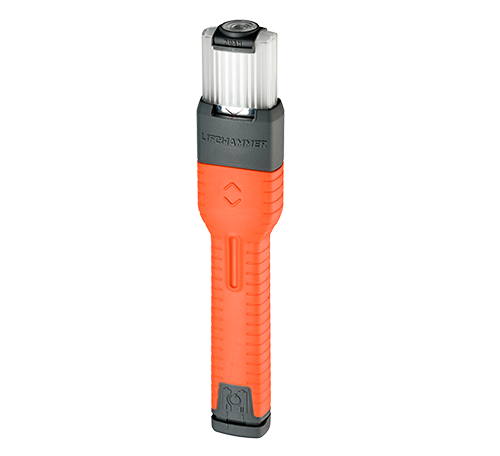
Beyond the legally required items, there are several pieces of equipment that can genuinely make a difference in an emergency. These include, above all, a safety hammer, enough high-visibility vests for all passengers, and a flashlight for low-visibility conditions.
A sensible addition to the basic kit includes:
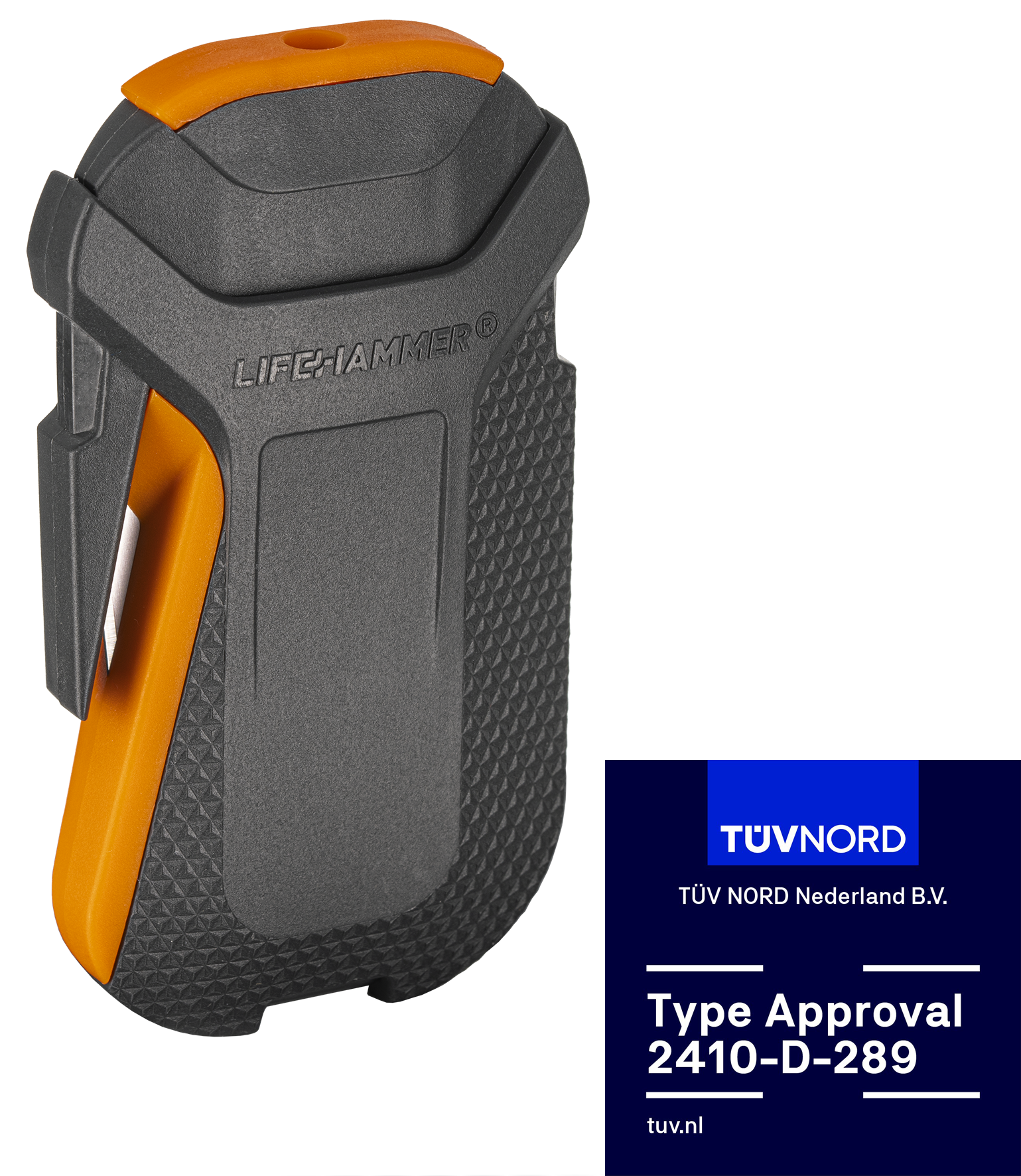
- Safety hammer with seatbelt cutter: Can cut through a seatbelt in an emergency and break tempered glass side windows (ESG)
- High-visibility vests for all occupants: Not just for the driver, but also for passengers and children
- Flashlight: For breakdowns in the dark or in tunnels
- Fire extinguisher: Particularly recommended for long-distance driving
- Jump leads or a jump starter power bank: In case of a flat battery
The safety hammer in particular is often underestimated. Modern vehicles increasingly feature electronically controlled windows and door locks. If the electronics fail following an accident, windows and doors can often no longer be opened in the normal way.
When is an emergency hammer in the car especially important?
An emergency hammer is especially important when a vehicle enters water, when there is a risk of fire, or when doors and windows can no longer be opened after an accident. In these situations, seconds can be decisive, and having a working tool within reach makes all the difference.
Vehicles with electric windows and electronic central locking are particularly vulnerable in an emergency. Once the power supply is cut, these systems stop working. A safety hammer makes it possible to break a tempered glass side window (ESG) and create a way out.
Important to know: windshields are typically made of laminated safety glass, which cannot be broken with a safety hammer. A safety hammer works reliably only on side windows and the rear window, provided these are made of tempered glass (ESG). If in doubt, it is worth consulting the vehicle documentation.
Where in the car should safety equipment be stored?
Safety equipment should be stored so that it is quickly and easily accessible in an emergency, without having to search for it. The safety hammer should be within the driver’s reach — at the driver’s door or on the center console. The high-visibility vest, warning triangle, and first aid kit can be kept in the trunk.
When it comes to the safety hammer, the rule is simple: it is useless if it is buried deep in the trunk. Mount it so that you can grab it immediately, even while buckled in and under stress. Many models can be attached directly to the driver’s door or the center console.
The high-visibility vest, on the other hand, is legally required to be within easy reach inside the passenger compartment — not in the trunk. This is especially important because it should be put on before leaving the vehicle. A vest that has to be retrieved from the trunk first defeats its purpose on a busy road.
What safety equipment makes a practical gift?
Car safety equipment makes a great gift because it has real everyday value and is relevant to almost every driver. Safety hammers, high-visibility vests, and flashlights are particularly well-suited, as they are compact, durable, and easy to use.
For people who have just passed their driving test, bought a new car, or travel frequently, a well-thought-out safety kit is a thoughtful and useful gift. It shows you care without being intrusive, and it is something that will genuinely be used in everyday life.
What to look for when choosing:
- Certification: Look for tested products, such as TÜV-certified safety hammers
- Compactness: Smaller products are easier to store in the vehicle
- Completeness: A set containing a safety hammer and a high-visibility vest is more practical than individual items
- Quality: Cheap imitations can fail when it matters most; reliable branded products are the better choice here
How Lifehammer® supports vehicle safety
Since 1983, we have been developing TÜV-certified safety products for vehicles that work reliably exactly when they are needed. Our range covers the most important areas of vehicle safety.
- Lifehammer® Safety Vest Ultra: Exceptionally compact and can be stored discreetly under the floor mat. It is ready for immediate use in an emergency and meets all legal requirements.
- Four models for every need: The Lifehammer® Classic and the Lifehammer® Plus feature a manual hammer head made of hardened carbon steel. The Lifehammer® Evolution and the Lifehammer® Smart use an automatic ceramic hammer head. All four models come with a seatbelt cutter and reliably break tempered glass side windows (ESG).
- Easy installation: Depending on the model, the safety hammer can be mounted using the included Allen key or with 3M adhesive tape, keeping it always within reach.
For more information and answers to frequently asked questions about our products, visit our Questions and Answers section.