 English
 Nederlands
 Deutsch







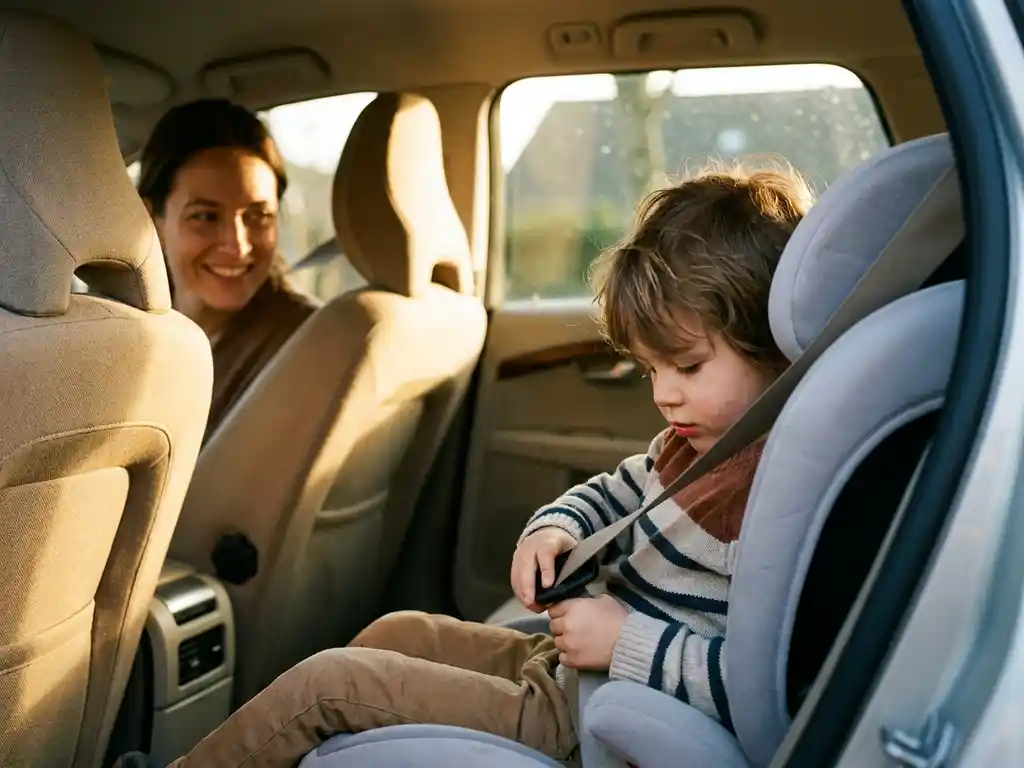
Yes, children can begin learning car safety skills well before they start school. Toddlers as young as two or three can understand and follow simple car safety rules, such as sitting still in their seat and waiting for a grown-up before opening a door. The earlier these habits are introduced, the more naturally they become second nature. The questions below explore what young children can realistically learn, how parents can teach it, and where the boundaries between car safety and road safety education lie.
At what age can children start learning car safety rules?
Children can start learning basic car safety rules from around age two. At this stage, learning happens through repetition, routine, and imitation rather than explanation. Toddlers absorb consistent patterns quickly, which makes the car an ideal environment for building safe habits early. By age four or five, most children can understand simple reasons behind the rules they follow.
The key is to match expectations to a child’s developmental stage. A two-year-old cannot understand why a seatbelt protects them in a collision, but they can learn that buckling up is simply what happens before the car moves. A four-year-old can begin to grasp cause and effect, making it possible to introduce brief, honest explanations alongside the rules themselves.
Parents who introduce car safety consistently from the earliest journeys tend to face far less resistance as children grow older. The rules feel normal because they always have been.
What car safety concepts can toddlers and preschoolers actually understand?
Toddlers and preschoolers can reliably understand concrete, action-based car safety concepts. These include staying in their seat, keeping their seatbelt on, not distracting the driver, waiting before opening a door, and not touching controls. Abstract concepts such as speed, force, or injury risk are beyond most children under five, but behavioural rules are well within reach.
What works at this age is simplicity and repetition. Rules framed as clear, positive instructions land better than rules framed around consequences. “We keep our seatbelts on while the car is moving” works better than a detailed explanation of what happens if they do not.
Preschool-age children also respond well to ownership. Letting a child check their own buckle, or asking them to remind a sibling, gives them a sense of responsibility that reinforces the habit. It turns a rule into a role.
How can parents teach car safety to young children at home?
Parents can teach car safety to young children through consistent routines, play-based learning, and calm, matter-of-fact conversations. The most effective teaching happens not in formal sessions but in the small moments around every journey. Making the same actions part of every trip, every time, builds habits that children carry into adulthood.
At home, role play is a useful tool. Children who act out getting into a car, buckling a seatbelt, and waiting for a signal before opening a door are practising the sequence in a low-pressure environment. Toy cars, dolls, and simple games can all be used to reinforce the same behaviours.
Books and stories that feature cars and travel are another gentle way to introduce concepts. When a character in a story buckles up or waits at a door, parents can pause and connect it to what the family does in real life. These small moments of recognition help children link rules to real situations.
Consistency between caregivers matters enormously. When every adult in a child’s life follows the same car safety routines without exception, children receive a clear, unified message. Inconsistency, even occasional inconsistency, introduces doubt and makes rules feel optional.
Should children know what to do if they are ever trapped in a car?
Children old enough to understand basic instructions, typically from around age four or five, can benefit from knowing a few simple actions to take if they are ever alone or trapped in a car. These include staying calm, calling out for help, pressing the horn, and knowing that car windows can be broken from the inside in an emergency. Age-appropriate preparation is about equipping children, not frightening them.
The conversation does not need to be dramatic or detailed. Framing it as “here is what you do if you ever need help” rather than describing specific accident scenarios keeps the tone calm and constructive. Children respond well to knowing they have a plan, and that knowledge can reduce panic in an unexpected situation.
For older children, it is worth explaining that most car windows are made of tempered glass, which can be broken with a sharp, focused point of impact rather than brute force. Knowing this can make the difference between a child feeling helpless and a child feeling capable. Safety tools designed to break tempered glass, such as a car escape hammer, are worth discussing with older children and teenagers as part of a broader family conversation about being prepared.
What’s the difference between car safety rules and road safety education?
Car safety rules and road safety education are related but distinct areas of learning. Car safety rules focus on behaviour inside the vehicle, such as wearing a seatbelt, sitting correctly in a child seat, and not distracting the driver. Road safety education covers behaviour outside the vehicle, including crossing the road safely, understanding traffic signals, and being visible to drivers as a pedestrian or cyclist.
Both are important, but they develop at different rates. Car safety habits can be introduced from infancy through routine, while road safety education typically becomes more active and explicit once a child starts walking independently or attending school.
For preschool-age children, car safety is generally the more immediately relevant area. They spend significant time in vehicles but limited time navigating roads independently. Road safety education builds on a foundation of spatial awareness and traffic understanding that develops gradually through early childhood. Parents often find it helpful to keep the two areas separate in early conversations, introducing road safety concepts progressively as a child’s independence grows.
How do schools and nurseries reinforce car safety learning?
Schools and nurseries reinforce car safety learning primarily through structured drop-off and pick-up routines, road safety programmes, and classroom activities that touch on travel and transport. Many early years settings use circle time, stories, and role play to introduce safe behaviours around vehicles. Formal road safety education often begins in reception or the first year of primary school.
In the UK and across much of Europe, road safety organisations provide age-appropriate materials to nurseries and schools that include car safety elements alongside pedestrian and cyclist safety. These programmes are designed to complement what children learn at home rather than replace it.
Parents can support this reinforcement by asking children what they have learned at nursery and connecting it to real journeys. When a child mentions something from school, acknowledging it and practising it together strengthens the message. Schools teach the concept; consistent home routines make it a habit.
It is also worth noting that teachers and nursery staff model car safety behaviours during school trips and outings. Children observe adults buckling up, waiting for signals, and following vehicle rules, and those observations carry real weight at an age when imitation is a primary mode of learning.
How Lifehammer® supports you with car safety for children
At Lifehammer® we have been developing vehicle safety tools since 1983, and supporting families with the right tools for unexpected situations is exactly what we focus on. Whether you are thinking about what to keep within reach in your car or how to feel better prepared for the journeys you take every day with children on board, we design products that are reliable, practical, and trusted by professionals across Europe.
- Our safety hammer range includes four models. The Classic and Plus use a hardened carbon steel hammerhead; the Safety Hammer Evolution and Smart use an automatic ceramic hammerhead. All four cut seatbelts and break tempered side and rear windows.
- All Lifehammer® safety hammers are TÜV certified according to German standards and are trusted by first responders, firefighters, and law enforcement across Europe, giving you confidence in a product that genuinely works when it matters.
- Our products are designed for ease of use by adults and older children alike, with ergonomic grips and clear single-action mechanisms that do not require strength or prior training to operate.
- Keeping a safety hammer mounted and accessible in your car, within reach but out of young children’s hands, is a practical step that complements the safety conversations you are already having with your family.
If you have questions about which product suits your car or your family’s needs, our Q&A section covers the most common topics in straightforward detail.