 English
 Nederlands
 Deutsch







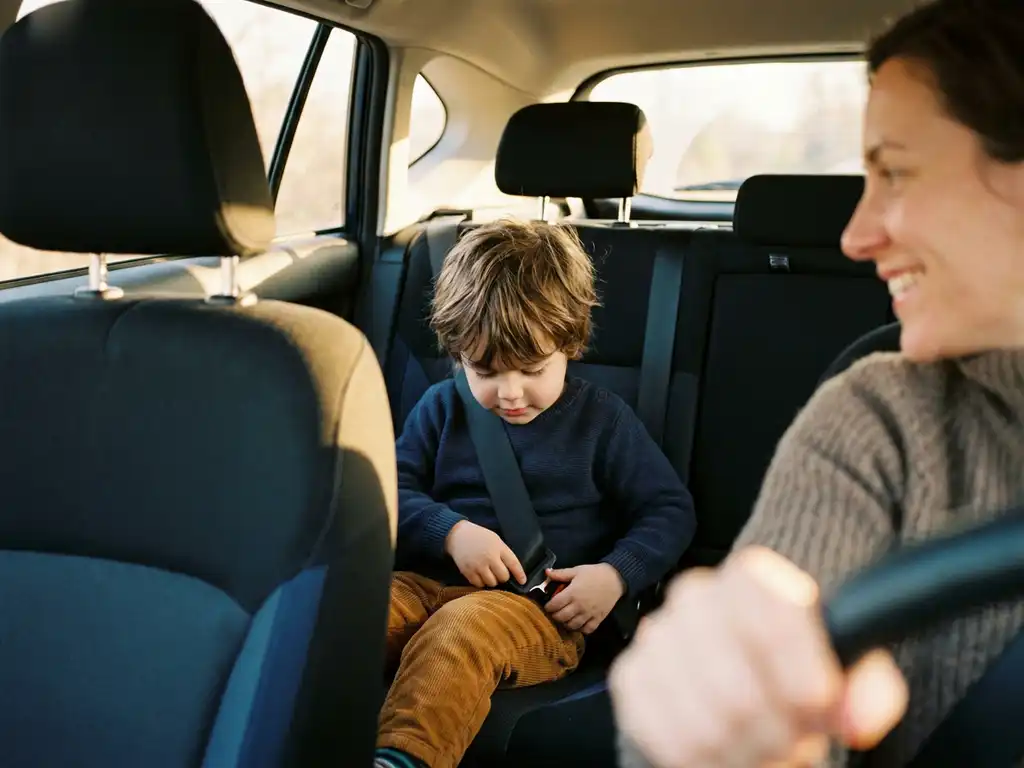
Most children can begin understanding basic car safety rules from around age two, though true comprehension of why rules exist develops gradually between ages four and seven. By school age, many children can follow car safety rules independently and even remind others. The sections below walk through each developmental stage and offer practical guidance for parents who want to build safe habits early.
What car safety concepts can toddlers (ages 1–3) grasp?
Toddlers cannot yet understand rules in any abstract sense, but they can learn simple, repeated routines. At this age, car safety for kids is about consistent physical habits: sitting in their car seat, staying still while being buckled, and not touching door handles. Repetition and calm, positive reinforcement are the most effective tools available to parents.
What toddlers respond to is patterns and predictability. When the same sequence happens every single time — get in, sit down, buckle up, then the car moves — young children begin to associate these steps with how travel works. They are not following a rule; they are following a script that feels normal to them. That is actually a strong foundation for genuine rule-following later on.
Keep language simple and consistent. Phrases like “we always buckle first” work better than explanations about why. At this stage, the goal is not comprehension but habit formation. The car seat itself does most of the safety work, so your role is to make sitting in it feel completely routine rather than optional.
When do children start understanding rules rather than just routines?
Children begin transitioning from routine-following to genuine rule-understanding roughly between ages four and six. At this point, a child can start to grasp that rules exist for a reason, even if they cannot fully articulate why. This is when teaching car safety rules for children becomes more interactive and conversational rather than purely repetitive.
Around age four, many children can answer simple cause-and-effect questions. “What do you think would happen if you weren’t buckled and the car stopped suddenly?” becomes a conversation they can participate in, rather than a concept that goes over their heads. You do not need to describe frightening scenarios to make the point. Framing it around comfort, staying safe, and being ready is enough.
Between five and seven, children also develop a stronger sense of social rules and fairness. They understand that rules apply to everyone, including adults. This is a good age to model behaviour explicitly: buckle your own seatbelt first, every time, and narrate what you are doing. Children at this stage notice inconsistency, and they learn as much from what they observe as from what they are told.
What car safety rules can school-age children (6–10) learn independently?
School-age children between six and ten can learn and independently follow a meaningful set of child car safety rules. By this age, they have the cognitive development to remember multi-step expectations, understand consequences, and take personal responsibility for their own behaviour in the car.
The following rules are realistic and age-appropriate for this group:
- Always buckle the seatbelt before the car moves — children this age can do this themselves and should be expected to.
- Keep hands, arms, and heads inside the vehicle — they understand why this matters when it is explained simply.
- Do not distract the driver — loud arguments, throwing objects, or demanding attention while the car is moving is something they can consciously control.
- Know what to do in a breakdown or emergency — stay calm, stay in the car unless told otherwise, and follow the adult’s instructions.
- Sit in the correct seat for their age and size — children can understand that booster seats and rear seating are about their safety, not a punishment.
At this age, children also benefit from being included in safety conversations rather than just receiving instructions. Explaining that the car has safety tools on board, and that adults plan ahead for unexpected situations, builds a sense of reassurance rather than anxiety.
How can parents teach car safety without causing fear?
Teaching kids car safety effectively means focusing on preparedness and capability rather than danger and worst-case outcomes. Children pick up on adult anxiety, so the tone of safety conversations matters as much as the content. The goal is to help children feel informed and capable, not worried.
Use calm, matter-of-fact language
Describe safety rules the same way you would describe any other household rule. “We wear our seatbelts because that is how we travel safely” carries the same weight as “we wash our hands before eating” — it is simply what the family does. Avoid dramatic hypotheticals or accident scenarios. Children do not need to imagine something frightening to understand that a rule is important.
Make safety feel like a shared family value
When safety is framed as something the whole family takes seriously together, children absorb it as a normal part of life. Point out safety features in the car with curiosity rather than worry. Show children where the first aid kit is kept, explain what the warning triangle is for, and let them see that prepared families think ahead. This builds confidence, not fear.
Older children in the six-to-ten range can also be given small responsibilities, such as reminding a younger sibling to buckle up. Giving children an active role reinforces the message and builds a sense of shared responsibility within the family.
What safety tools should every family car carry for emergencies?
Every family car should carry a small set of emergency tools that can help occupants respond effectively if something unexpected happens. A basic car emergency kit for families includes a safety hammer capable of breaking tempered side window glass, a seatbelt cutter, a high-visibility safety vest, a first aid kit, and a warning triangle or road flares.
Of these, a car escape tool — combining window-breaking and seatbelt-cutting functions — is particularly worth having within easy reach. In situations where a door cannot be opened or a seatbelt becomes jammed, having a tool that any family member can use quickly makes a real difference. Look for tools with a spring-loaded or low-force mechanism, which can be operated by adults and older children alike.
A safety vest is equally practical. In a breakdown situation, visibility is one of the most important factors in staying safe on the roadside. Compact vests that store easily under a seat or in a door pocket mean they are actually available when needed rather than buried in the boot.
Teaching older children where these tools are stored and how they work is a natural extension of car safety education at the school-age stage. It does not need to be presented as preparation for disaster — it is simply part of knowing your vehicle, the same way a child might learn where the spare tyre is kept.
How Lifehammer® supports families with car safety
We have been developing TÜV-certified car safety products since 1983, built around one principle: tools that work reliably when they are actually needed. For families, that means products that are straightforward to use, easy to store within reach, and effective regardless of who needs to use them.
- Designed for all family members: Our safety hammers feature a spring-loaded mechanism that requires minimal force, making them usable by adults and older children alike. The non-slip grip is designed to function under stress.
- Window breaking and seatbelt cutting in one tool: All our models break tempered side window glass (ESG) and include a protected blade for cutting through a jammed seatbelt — two of the most important capabilities in a car escape situation.
- The Safety Hammer SMART: A slim, modern design that mounts using 3M VHB double-sided adhesive tape, no screws required. It works with a ceramic pin striking mechanism and fits discreetly within reach of the driver or passenger.
- Trusted by professionals: Police officers, firefighters, and first responders have relied on Lifehammer® products for decades — a standard of reliability that translates directly to family use.
If you have questions about which product suits your vehicle or family setup, you will find detailed answers in our questions and answers section.