 English
 Nederlands
 Deutsch





Driving in fog is more dangerous than driving in rain because fog reduces visibility far more severely and unpredictably. Rain dims your surroundings, but fog can cut your visible range to just a few metres, removing nearly all the visual information you rely on to judge speed, distance, and road position. The sections below break down exactly why fog creates such distinct hazards and what you can do to stay prepared.
How does fog reduce visibility differently than rain?
Fog reduces visibility by suspending tiny water droplets directly in the air at eye level, creating a dense, uniform wall of white that absorbs and scatters light in every direction. Rain falls vertically and clears from your line of sight almost immediately. Fog does not move out of the way — it surrounds you, and it does so at the exact height where you need to see the road ahead.
The result is a loss of depth perception. In rain, you can still see the outline of the road, the car ahead, and the horizon. In fog, those reference points disappear entirely. What makes this especially disorienting is that fog is rarely uniform. You can drive through a clear patch and then hit a dense bank within seconds, leaving you with almost no time to adjust your speed or position. This unpredictability is what separates fog from rain as a visibility hazard.
Fog also tends to appear suddenly in specific locations — low-lying areas, river valleys, motorway underpasses, and open fields — meaning you can be in clear conditions and then inside a fog bank within a single second of driving.
Why do headlights make fog more dangerous, not less?
Standard headlights make fog more dangerous because they project light forward into the suspended droplets, which then scatter that light back towards you. Instead of illuminating the road ahead, your headlights create a bright wall of reflected light — known as glare or backscatter — that actually reduces how far you can see. The brighter your headlights, the worse this effect becomes.
This is why high beams are actively harmful in fog. Switching to full beam in fog is one of the most common mistakes drivers make, and it can reduce your effective visibility to almost nothing. Fog lights, by contrast, are mounted lower on the vehicle and project a wide, flat beam beneath the fog layer, illuminating the road surface rather than the droplets above it.
The same backscatter problem applies to the fog lights of the vehicle in front of you. Their rear fog lights can appear far brighter than they actually are through the fog, making it difficult to judge how close they really are. Many drivers instinctively follow the lights ahead without realising they have closed the gap significantly.
What makes judging speed and distance so hard in fog?
In fog, your brain loses the visual anchors it normally uses to calculate speed and distance. You rely on fixed reference points — road markings, verges, other vehicles, buildings, the horizon — to gauge how fast you are moving and how far away objects are. Fog removes most of those references, leaving your perception unreliable and often dangerously optimistic.
Studies in visual perception consistently show that when the environment lacks contrast and depth cues, people underestimate both their own speed and the proximity of objects ahead. In fog, a car that appears to be 50 metres away may be significantly closer. A vehicle that feels stationary may be moving slowly rather than stopped.
This perceptual distortion is compounded by the fact that fog muffles sound. You lose the audio cues — engine noise, tyre sounds from other vehicles — that normally supplement your visual sense of the road. The result is that driving in fog places an unusually high cognitive load on the driver, with far less reliable information coming in than under normal or even wet conditions.
How does fog affect stopping distances and reaction time?
Fog does not directly extend stopping distances the way wet or icy roads do, but it dramatically reduces the time you have to react to a hazard. If your visibility is limited to 30 metres and you are travelling at 60 kilometres per hour, you have less than two seconds before you reach what you can see. At that speed, your stopping distance alone — even under ideal conditions — is already beyond what fog allows you to see ahead.
The two-second rule that applies to normal driving becomes almost meaningless in dense fog, because the gap you would need to maintain between yourself and the vehicle ahead is often greater than your entire visible range. This is why rear-end collisions are the most common type of accident in foggy conditions.
Reaction time itself can also be affected. The cognitive effort of processing a reduced, distorted visual field tires the brain more quickly than normal driving. Drivers in fog often report a heightened sense of concentration that is actually a sign of how much harder the brain is working — and how much faster fatigue can set in.
What should you keep in your car for low-visibility driving?
For low-visibility driving, the most useful items to keep in your car are a high-visibility safety vest, a torch, a warning triangle, and a car escape tool. These cover the two main risks of fog driving: the hazard of being involved in an incident, and the hazard of being stranded on a road where other drivers cannot see you.
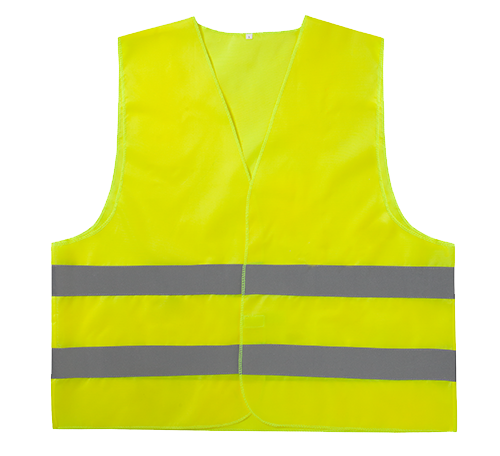
- High-visibility vest: If you need to exit your vehicle in fog — whether due to a breakdown or an incident — a vest makes you visible to approaching traffic before they are close enough to stop. In many European countries, carrying one is a legal requirement.
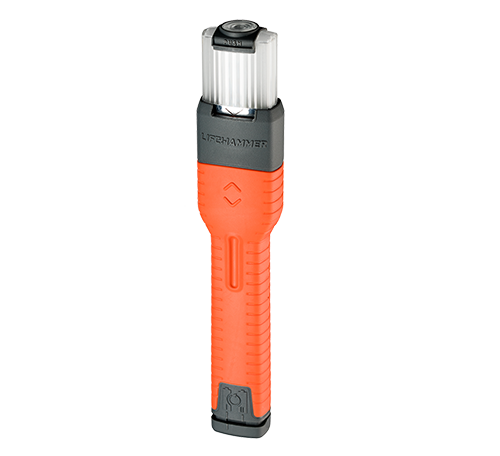
- Torch: Fog reduces ambient light significantly, and a reliable torch is useful both for signalling and for checking your vehicle safely at the roadside.
- Warning triangle: Placed at a safe distance behind your vehicle, a warning triangle gives approaching drivers additional time to react — particularly important when visibility is already compromised.
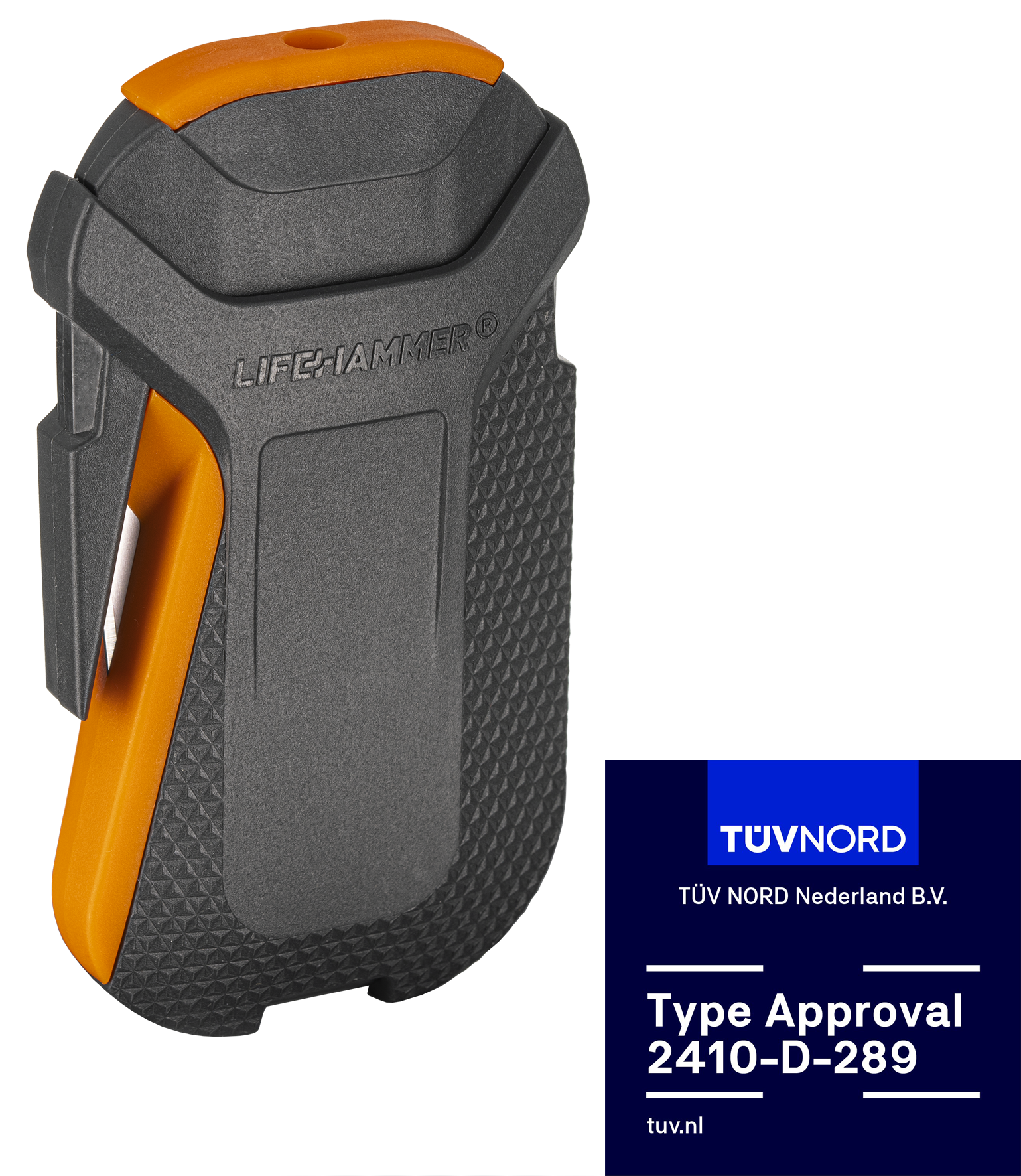
- Car escape tool: In the event of a serious incident, a safety hammer allows you to cut a seatbelt and break a tempered side window quickly, without relying on electronics that may have failed in a collision.
Keep these items where you can reach them easily — not buried in the boot under luggage. A vest stored under the driver’s seat or a safety hammer mounted within arm’s reach of the driver is far more useful than the same items packed away where they cannot be accessed quickly.
When is fog officially considered dangerous enough to avoid driving?
Fog is officially classified as dangerous when visibility drops below 100 metres. At this threshold, most European countries require drivers to use fog lights, and many transport authorities issue formal weather warnings advising against non-essential travel. Below 50 metres of visibility, driving conditions are considered severe, and road safety organisations consistently advise postponing journeys where possible.
The UK’s Highway Code, for example, specifically states that fog lights should be used when visibility falls below 100 metres — roughly the length of a football pitch. At this distance, a vehicle travelling at motorway speed would cover that gap in under four seconds, leaving almost no margin for reaction.
The practical answer for most drivers is straightforward: if you cannot see far enough ahead to stop safely within your visible range, you are driving too fast for conditions — regardless of what the speed limit says. If conditions make that impossible to achieve at any reasonable speed, the journey should wait.
How Lifehammer® supports you with low-visibility driving
At Lifehammer® we have been developing vehicle safety tools since 1983, and low-visibility driving is exactly the kind of situation our products are designed for. Fog creates conditions where a breakdown or incident can escalate quickly, and being equipped with the right tools in your car makes a real difference to how safely you can respond.
- Our Safety Vest Ultra comes in an ultra-flat vacuum pack that stores discreetly under any floor mat and decompresses immediately on opening. It is one-size-fits-all and suitable for drivers and passengers alike — exactly what you need if you have to exit your vehicle on a foggy road.
- Our safety hammer range includes four models. The Classic and Plus use a manual hardened carbon steel hammerhead; the Evolution and Smart use an automatic ceramic hammerhead. All four cut seatbelts and break tempered side windows.
- All Lifehammer® safety hammers are TÜV certified and trusted by first responders and fleet operators across Europe — the same standard of reliability that matters when conditions are at their worst.
If you have questions about which products are right for your car or your driving conditions, our Q&A section covers the most common topics in straightforward detail. You can also find our products on Amazon if you prefer to order directly.