 English
 Nederlands
 Deutsch



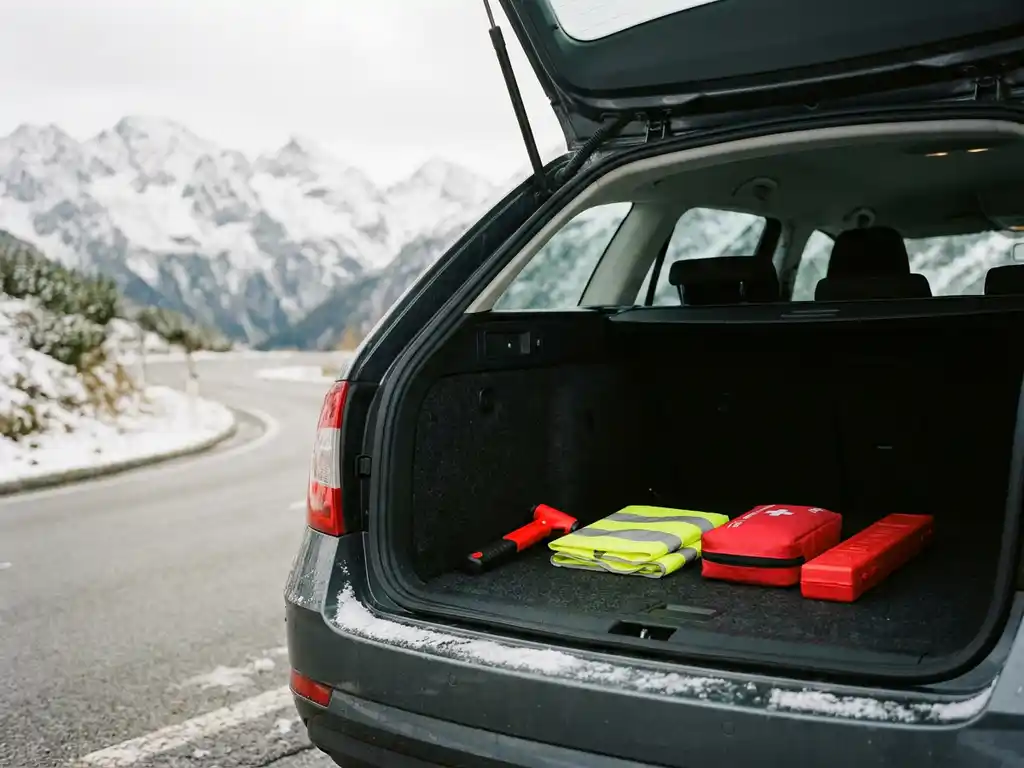
In Austria, drivers are required by law to carry a warning triangle, a first aid kit, and a high-visibility vest. These three items are mandatory for all vehicles traveling on Austrian roads. Drivers who want to be well prepared can also carry additional useful equipment that could make a real difference in an emergency.
Which items are legally required in a car in Austria?
Under Austria’s Motor Vehicles Act, three items are compulsory for passenger car drivers: a warning triangle, a first aid kit, and a high-visibility vest. This equipment must be kept in the vehicle and be ready for use in the event of a breakdown or accident. Different rules apply to motorcycles — for example, a warning triangle is not required for them.
The warning triangle
A warning triangle must be present in the vehicle and in working condition. It is used to alert other road users to a hazard when a vehicle has broken down or is involved in an accident. The triangle should be stored in an easily accessible location in the trunk so it can be deployed quickly when needed.
The first aid kit
The first aid kit must comply with the current Austrian standard. In Austria, ÖNORM V 5101 applies, which specifies the required contents in detail. First aid kits have an expiration date, as bandaging materials lose their sterility over time. It is worth checking the kit regularly and replacing any expired items in good time. An outdated or incomplete first aid kit will be considered non-compliant during an inspection.
The high-visibility vest
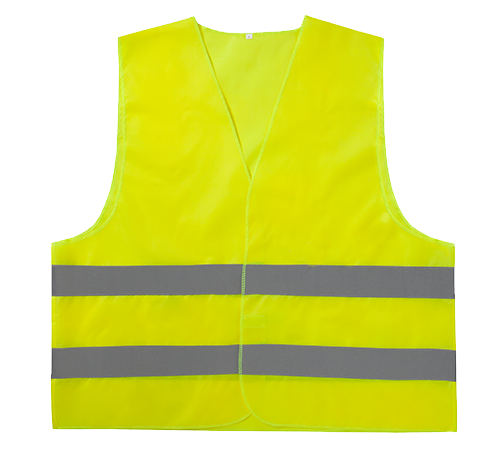
Since 2014, at least one high-visibility vest per vehicle has been mandatory in Austria. It must be kept within easy reach inside the vehicle — not in the trunk. The vest must comply with EN ISO standard 20471. It is advisable to keep a vest for every occupant, even though the law only requires one.
What are the consequences of not carrying the required equipment?
Driving in Austria without the legally required equipment constitutes an administrative offense and can result in a fine. The amount of the fine depends on the specific violation and may vary depending on the authority and circumstances. Equipment is checked during police inspections and following accidents.
The absence of required equipment is particularly problematic after an accident. Drivers who cannot set up a warning triangle or are not wearing a high-visibility vest put not only themselves but also other road users at risk. In addition to a fine, this can have insurance implications if the lack of safety measures contributed to worsening an accident.
Specific fine amounts are subject to change, so it is advisable to check the current regulations with ÖAMTC or ARBÖ, or to consult the official legislation. As a general rule: the cost of a complete set of required equipment is significantly lower than a single fine.
What else belongs in a well-equipped car beyond the legal requirements?
Beyond the legally required minimum, there are a number of useful items that make any vehicle safer and more practical. Drivers who regularly cover longer distances or travel with family will benefit from being prepared for unexpected situations as well.
The following items are not required by law but are nonetheless worthwhile:
- Jump leads or a portable jump starter: A flat battery is one of the most common causes of breakdowns. A compact jump starter lets you restart without the help of another car.
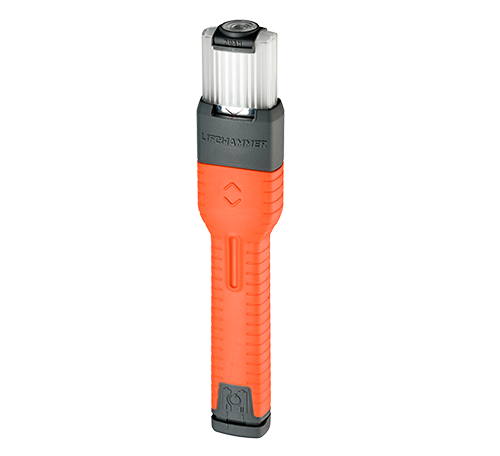
- Flashlight: Essential for dealing with a breakdown in the dark.
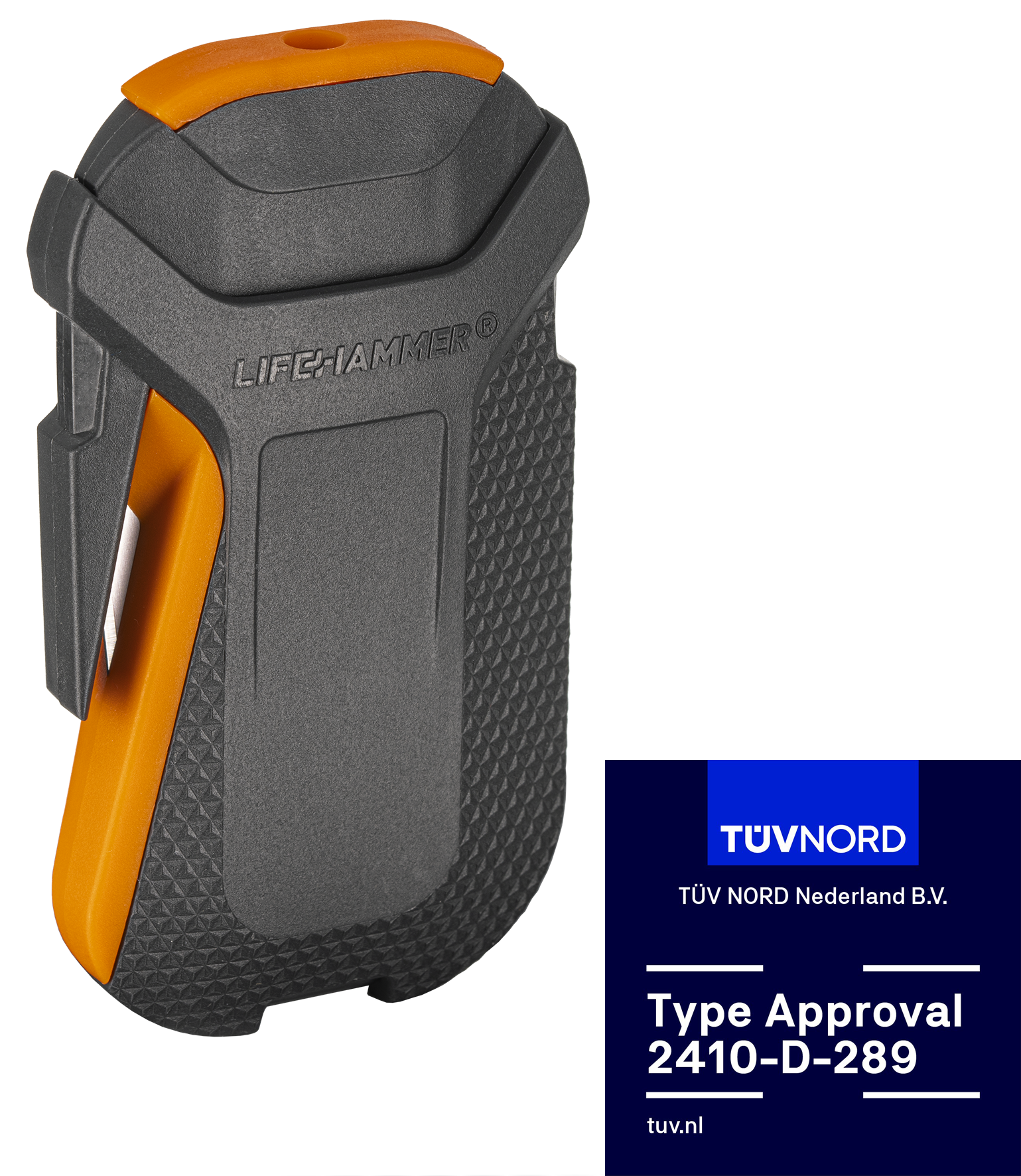
- Safety hammer with seatbelt cutter: Allows you to break a tempered side window and cut through a jammed seatbelt. Keep it within easy reach inside the vehicle, not in the trunk.
- Tire repair kit or spare wheel: Not all modern vehicles include a spare wheel. A repair kit provides at least a temporary solution.
- Fire extinguisher: Not required for passenger cars in Austria, but recommended.
A well-thought-out set of vehicle equipment is not a matter of fear — it is a matter of foresight. Being prepared means you can respond more calmly in a stressful situation and help others more quickly.
Do Austrian equipment requirements also apply to foreign vehicles?
Yes, Austria’s mandatory equipment regulations apply to all vehicles traveling on Austrian roads, regardless of the country of registration. Anyone driving through Austria with a German, Swiss, or Czech license plate must carry the same minimum equipment as an Austrian driver.
This means: a warning triangle, a first aid kit meeting Austrian standards, and a high-visibility vest must all be present in the vehicle. Foreign first aid kits that comply with other national standards may be deemed insufficient during an inspection if they do not meet Austrian requirements.
Drivers who regularly travel through multiple European countries should also familiarize themselves with the applicable national regulations in each country. In some countries, for example, a fire extinguisher is mandatory, while others require a specific number of high-visibility vests. Requirements vary considerably from country to country, and ignorance of the law is no protection against fines.
When must you put on a high-visibility vest in Austria?
In Austria, a high-visibility vest must be worn as soon as you exit your vehicle on the road or on the hard shoulder following a breakdown or accident. The requirement therefore does not apply while driving, but rather from the moment you become a pedestrian in traffic and need to be visible.
Importantly, the vest must be put on before you exit the vehicle. This means it should be kept within easy reach inside the passenger compartment, not in the trunk. Anyone who has to open the trunk to retrieve the vest is already unprotected on the road at that moment.
The requirement applies on all roads, not just highways. Even during a breakdown on a rural road or in a built-up area, the vest should be worn as soon as you step out. This is especially important at night or in poor visibility conditions, as the risk of other road users failing to see a person on the road is significantly higher.
If multiple occupants exit the vehicle, ideally everyone should wear a high-visibility vest. While Austrian law only requires one vest per vehicle, the same duty of care applies to all passengers. Anyone traveling with children or multiple people is better off carrying several vests.
How Lifehammer® supports vehicle safety in Austria
At Lifehammer®, we have been developing reliable vehicle safety products since 1983 — products that work exactly when you need them. Our products are TÜV-certified to German standards and are used by emergency services including police and fire departments. For anyone who wants to equip their vehicle sensibly beyond the legal minimum, we offer concrete solutions:
- Safety hammer with seatbelt cutter: The Lifehammer® product line includes four safety hammers: the Safety Hammer Classic and the Safety Hammer Plus feature a manual hardened carbon steel hammerhead. The Safety Hammer Evolution and the Safety Hammer Smart use an automatic ceramic hammerhead. All four models are equipped with a seatbelt cutter and reliably break side windows made of tempered glass. Easy installation: no screws required. Attaches to the car door or center console, stays securely in place, and is immediately at hand in an emergency.
- High-visibility vest in vacuum packaging: Our Safety Vest Ultra comes in an ultra-flat vacuum pack that unfolds when opened. It fits discreetly under any floor mat, is one size fits all, and complies with EN ISO standard 20471.
- All products are developed for the European market and meet the relevant safety standards.
If you have questions about our products or about equipping your vehicle correctly, you will find more information on our FAQ page.