 English
 Nederlands
 Deutsch






Yes, most older drivers can use a safety hammer in an emergency, but ease of use varies depending on the design of the tool and the individual’s physical capabilities. A spring-loaded or pressure-activated model tends to be more accessible than one that requires a full swinging motion. The sections below address the specific factors that matter most for older adults considering a car escape tool.
What makes a safety hammer easy or difficult to use?
A safety hammer is easy to use when it requires minimal force, fits comfortably in the hand, and can be operated with a single controlled motion. Difficulty increases when the tool demands a wide swinging arc, a firm two-handed grip, or precise aim under pressure. The striking mechanism, handle design, and how the tool is stored all influence how quickly and reliably it can be used in a real situation.
Traditional safety hammers work by delivering a sharp blow to a corner of a tempered glass window. Tempered glass is the single-pane safety glass used in most side and rear windows, and it shatters when struck at a point of concentrated force. This type of glass can be broken with a safety hammer. Laminated glass, by contrast, cannot be broken using a standard safety hammer and is typically found in windscreens.
Pressure-activated models take a different approach. Instead of swinging the tool, the user presses the tip firmly against the glass until a spring-loaded mechanism releases automatically. This removes the need for a swinging motion entirely, which can make a meaningful difference for anyone with limited arm mobility or reduced coordination.
Are safety hammers designed with older drivers in mind?
Not all safety hammers are designed with older users in mind, but some models do incorporate features that benefit people with reduced dexterity or strength. Ergonomic handles, non-slip grips, and pressure-activated mechanisms are design choices that make a car escape tool more accessible to older adults. The seatbelt cutter, which is typically built into the same tool, should also be operable with one hand and minimal grip force.
Older drivers benefit most from tools that do not require a wide range of motion or a strong overhead strike. A compact, well-balanced handle that sits naturally in the palm reduces the effort needed to position and activate the tool. Non-slip surfaces matter too, since hands may be damp or shaking in a stressful situation.
It is worth noting that no safety hammer guarantees effortless operation for every user. Physical ability varies considerably among older adults, and a tool that works well for one person may feel awkward for another. Choosing a model with a grip shape and activation method suited to the individual is more important than any single feature in isolation.
Can reduced grip strength affect how a safety hammer works?
Yes, reduced grip strength can affect how a safety hammer works, particularly with models that require a firm swing to generate enough force to break tempered glass. If the tool slips or the strike lacks sufficient impact, the glass may not shatter on the first attempt. For older drivers or anyone with conditions affecting hand strength, this is a genuine practical consideration when choosing a car escape tool.
Pressure-activated models partially address this limitation. Because the spring mechanism does the work of breaking the glass, the user only needs to press the tool against the window with enough sustained pressure to trigger the release. That said, a meaningful amount of force is still required to compress the spring and activate the mechanism. These tools do not work without physical effort.
The seatbelt cutter is equally important to consider. A recessed blade design, where the belt feeds into a slot and is cut with a pulling motion, tends to be easier to manage than a hook-style cutter that requires precise positioning. Older adults should check that the seatbelt cutter on any model they consider can be used comfortably with their current hand strength.
Where should older drivers keep a safety hammer in the car?
Older drivers should keep a safety hammer within arm’s reach of the driver’s seat, in a fixed position that does not require searching or stretching to locate. The most practical locations are the driver’s door pocket, a dedicated mount on the centre console, or a position on the dashboard or A-pillar within easy reach. The goal is to be able to locate and grip the tool quickly, even in a disorienting situation.
A loose tool stored in the glove compartment or boot is not useful in an emergency. If the car has come to rest at an angle, or the driver is partially immobilised, reaching across the car or behind the seat becomes difficult or impossible. A fixed mount keeps the tool exactly where the driver expects it.
When positioning a safety hammer using adhesive tape or a mounting bracket, avoid placing it in areas where an airbag could deploy. The driver’s side door, the A-pillar beside the driver, and the centre console between the front seats are generally suitable locations. Older drivers who find it easier to operate with their dominant hand should position the tool accordingly.
Should older drivers practise using a safety hammer before an emergency?
Yes, older drivers benefit from familiarising themselves with a safety hammer before an emergency occurs. Knowing where the tool is stored, how to grip it, and how to activate the window-breaking mechanism removes uncertainty in a high-stress situation. Muscle memory and familiarity with the tool’s weight and activation method can make a real difference when time and composure are limited.
Practising does not mean breaking glass at home. It means handling the tool regularly enough to know instinctively which end is the striker, how to hold it securely, and how to position it against a window. For pressure-activated models, understanding the amount of force required to trigger the spring mechanism is particularly useful.
Older drivers who share a car with a spouse or family member should ensure that the other person is also familiar with the tool’s location and operation. In an emergency, either person may need to act, and prior familiarity reduces hesitation significantly.
The Lifehammer® Evolution for older drivers
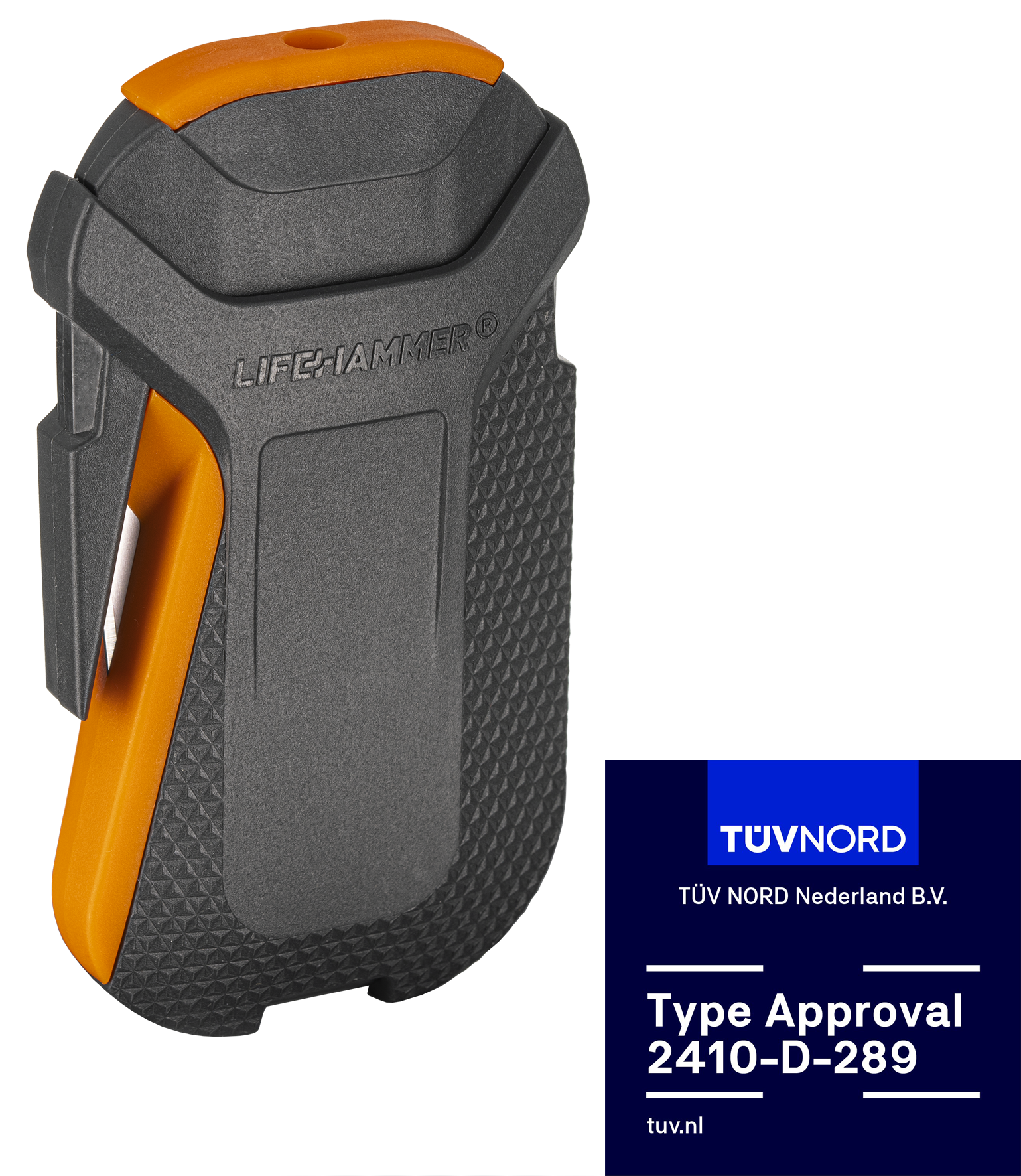
We developed the Lifehammer Evolution with usability in mind, and its design may suit older drivers particularly well. Instead of requiring a swinging blow, the Evolution uses a spring-loaded ceramic hammerhead that activates automatically when pressed firmly against tempered glass. This pressure-based mechanism removes the need for a wide arm movement, which can be an advantage for users with reduced shoulder mobility or limited grip strength.
- Spring-loaded ceramic hammerhead activates on contact with tempered glass, no swinging motion required
- Non-slip handle designed for a secure grip, which may support users with reduced hand strength
- Integrated seatbelt cutter operable with one hand
The Evolution does still require sufficient pressing force to trigger the mechanism. We do not claim it works without physical effort, and individual ability varies. For older adults who are uncertain whether this tool suits their specific needs, our questions and answers page covers common practical queries in detail. If you would like to order, the Lifehammer Evolution is available on Amazon for straightforward delivery.