 English
 Nederlands
 Deutsch




Most drivers have heard the word aquaplaning, but far fewer understand what is actually happening beneath their tyres when it occurs. It is one of those driving hazards that can appear without warning, last only a few seconds, and leave you with very little control. Understanding the mechanics behind it, what triggers it, and how your instincts can work against you in the moment gives you a genuine advantage on wet roads.
This article builds from the ground up, starting with what aquaplaning is and how it develops, through to the physical forces involved, the role your tyres play, and the conditions that make it more likely. By the end, you will have a clear picture of why aquaplaning happens and what it means for how you drive in wet weather.
What is aquaplaning and how does it happen?
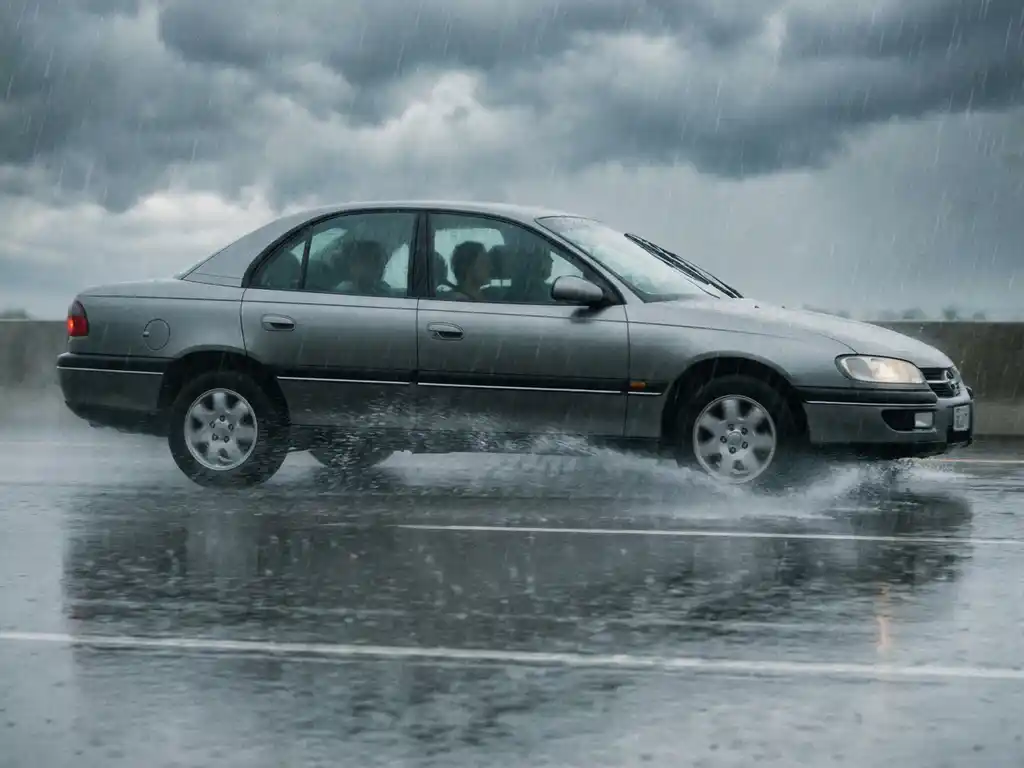
Aquaplaning, sometimes called hydroplaning, occurs when a layer of water builds up between your tyres and the road surface faster than the tyres can displace it. At that point, the tyre loses contact with the tarmac and rides on top of the water instead. The result is a loss of traction, steering response, and braking ability, all at once.
The process is not instantaneous. It develops progressively as speed increases and water depth rises. At lower speeds, your tyres can manage the water effectively, channelling it away through the tread grooves. As speed increases, the tyre reaches a point where it simply cannot move water out of the way quickly enough, and the wedge of water beneath it grows. Once that wedge is large enough, the tyre lifts off the surface entirely.
For example, imagine sliding a flat piece of rubber across a wet floor at walking pace. It grips. Slide it faster and it starts to skim. That transition from grip to skimming is essentially what happens during aquaplaning, though at tyre speeds and with far greater consequences.
The physics beneath your tyres during aquaplaning
Three forces interact during aquaplaning: the vehicle’s speed, the weight pressing the tyre down onto the road, and the pressure of the water building up in front of the tyre contact patch. When water pressure exceeds the downward force of the vehicle’s weight at a given speed, the tyre lifts.
The contact patch, which is the small area of the tyre actually touching the road at any given moment, is where all grip, steering, and braking force is generated. Under normal conditions, this patch is solid and consistent. During aquaplaning, the contact patch shrinks dramatically as the water wedge intrudes from the front of the tyre. In a full aquaplane, the contact patch may reduce to near zero.
This is why aquaplaning feels so disorienting. Your steering wheel may go light, your car may veer without input, and braking has almost no effect because there is nothing for the tyre to grip. The physics are working against you in every direction simultaneously.
What tyre tread depth has to do with water dispersal
Building on the mechanics above, tyre tread depth is the single most important factor in your tyres’ ability to resist aquaplaning. Tread grooves are not there for appearance. They are precisely engineered channels that move water away from the contact patch as the tyre rotates.
A new tyre with full tread depth can displace a significant volume of water per second at speed. As the tread wears down, that capacity reduces. A tyre worn close to the legal minimum limit moves far less water than a new one, which means the speed at which aquaplaning begins drops considerably.
- New tyres with deep tread manage water effectively at higher speeds
- Moderately worn tyres remain functional but begin aquaplaning at lower speeds than new ones
- Heavily worn tyres have very little water dispersal capacity and aquaplane much earlier
Tyre pressure also plays a role. An underinflated tyre has a wider, flatter contact patch, which increases the surface area exposed to water pressure. This makes aquaplaning more likely than with correctly inflated tyres. Checking both tread depth and tyre pressure before driving in wet conditions is a straightforward habit that makes a measurable difference.
Recognising the warning signs behind the wheel
Aquaplaning does not always arrive as a dramatic, sudden event. There are often early signals that your tyres are beginning to lose their grip on the road surface, and recognising them gives you a small but useful window to respond.
The first sign is often a lightening of the steering. The wheel feels vague or unresponsive, as though the connection between your input and the car’s direction has loosened. You may also notice the engine revving higher than expected, particularly in a rear-wheel-drive vehicle, as the driven wheels begin to spin freely on the water layer.
- Steering feels unusually light or disconnected
- The car begins to drift without steering input
- Engine revs rise without a corresponding increase in speed
- A faint vibration or change in road noise from the tyres
Full aquaplaning feels distinctly different from ordinary wet-road driving. The car may feel almost weightless at the front, and any attempt to steer or brake produces little or no response. Recognising this state quickly, rather than reacting with panic, is what determines how well you manage the next few seconds.
Why common instincts make aquaplaning worse
This is where prior driving experience can actually work against you. The instincts that help in most skids, such as braking hard or turning into the slide, are counterproductive during aquaplaning and can make the situation significantly worse.
Braking hard during aquaplaning locks the wheels, which removes any remaining chance of the tyre re-establishing contact with the road. A locked tyre cannot steer and cannot grip. If your vehicle has ABS, hard braking will activate it, which is better than locking up entirely, but the system is working with almost no traction to begin with.
Turning the steering wheel sharply is equally unhelpful. Because the tyre has no contact with the road, steering input has no effect. Worse, if the tyres suddenly regain grip mid-turn, the car can snap in the direction the wheels are pointing with significant force.
The correct response runs against instinct: ease off the accelerator smoothly, hold the steering wheel straight and steady, and allow the car to slow down gradually until the tyres regain contact. Do not brake sharply. Do not steer aggressively. Let the physics work in your favour by reducing speed and giving the tyres a chance to reconnect with the surface.
Driving conditions that raise the risk of aquaplaning
Aquaplaning is not equally likely in all wet conditions. Several specific factors combine to raise the risk, and being able to identify them helps you adjust your driving before a problem develops.
Speed is the most direct variable. The faster you travel, the less time your tyres have to displace water. On a motorway in heavy rain, the risk is considerably higher than on a slow urban road with light drizzle. Reducing your speed in wet conditions is the single most effective thing you can do to lower the risk.
- Heavy or sudden rainfall creates more surface water than tyres can easily manage
- Standing water and puddles are the highest-risk zones, particularly in dips or at the edges of lanes
- The first rain after a dry spell brings oil residue to the surface, reducing grip even before aquaplaning begins
- Motorway driving combines high speed with large water volumes, making it particularly demanding
- Road camber and drainage affect where water collects, and some lanes or bends accumulate more water than others
Worn road surfaces with poor drainage are also a factor. Smooth, polished tarmac holds water rather than channelling it away, which means aquaplaning can occur at lower speeds than on well-maintained roads. Being aware of road quality, especially on older motorways or heavily trafficked routes, gives you additional context for adjusting your speed and following distance.
How Lifehammer® supports you on wet-weather drives
At Lifehammer® we have been developing vehicle safety tools since 1983, and wet-weather preparedness is exactly the kind of situation our products are designed to complement. Understanding aquaplaning is one part of being a prepared driver. Having the right tools in your car is another.
- Our safety hammer range includes four models. The Classic and Plus use a manual hardened carbon steel hammerhead; the Evolution and Smart use an automatic ceramic hammerhead. All four cut seatbelts and break tempered side windows.
- All Lifehammer® safety hammers are TÜV certified and trusted by first responders and fleet operators across Europe.
- Our Safety Vest Ultra comes in an ultra-flat vacuum pack that stores discreetly under any floor mat and decompresses immediately on opening. It is one-size-fits-all and suitable for drivers and passengers alike.
If you have questions about which products suit your car or your driving habits, our Q&A section covers the most common topics in straightforward detail. And if you are ready to equip your car today, you can find Lifehammer® products on Amazon.